

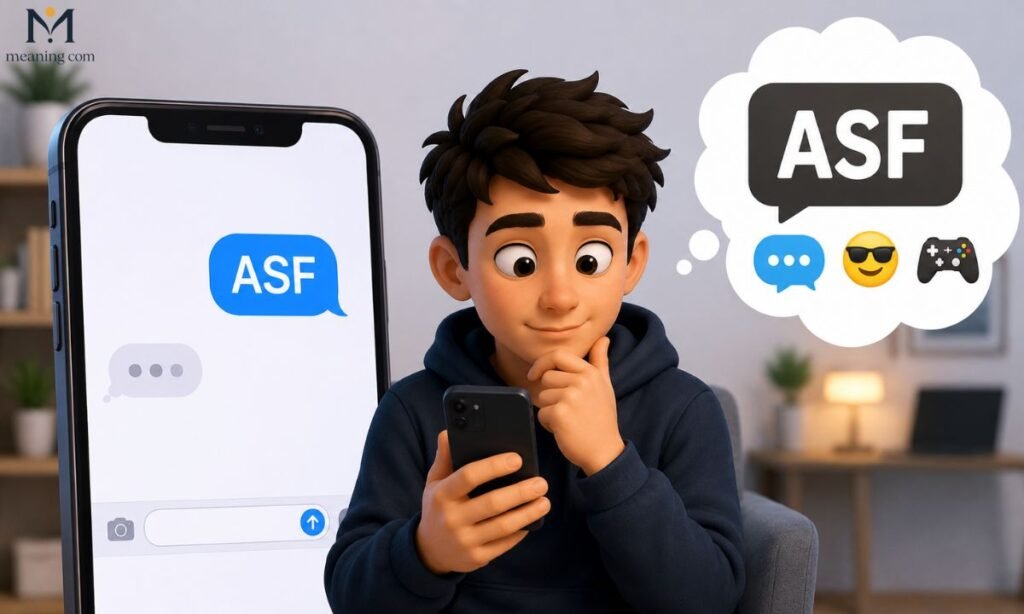
If you have ever received a text that said “I’m tired ASF” or scrolled past a comment that read “this is funny ASF,” you have probably paused for a second, wondering what exactly ASF means. You are not alone. This three letter acronym shows up constantly in texting, social media captions, gaming chats, and comment sections, and understanding it can save you from confusion (or an awkward reply).
This guide breaks down the ASF meaning in simple terms, explains where it came from, shows you how to use it naturally, and warns you about the situations where it is best avoided.
What Does ASF Mean?

ASF is an informal slang acronym that functions as an intensifier. In plain English, it means “very,” “extremely,” or “really.” When someone types “tired ASF,” they are saying they are extremely tired. When someone writes “hungry ASF,” they mean they are really hungry.
The acronym is almost always placed right after an adjective, and its job is simple: make the feeling, description, or reaction sound bigger and more intense than a plain sentence would.
You will most often see ASF in:
- Text messages between friends
- Instagram and TikTok captions and comments
- Twitter/X posts
- Gaming chats and Discord servers
- Casual online forums
ASF Full Form Explained
The full form of ASF is “as f***,” a mild profanity used as an intensifier in spoken English long before texting existed. Because the phrase contains a swear word, people began abbreviating it to ASF when typing, especially once texting and social media made short, quick expressions the norm.
Here is the simple breakdown:
| Letter | Stands For |
| A | As |
| S | (short for the swear word) |
| F | (short for the swear word) |
Because of this origin, ASF technically carries mild profanity, even though most people who use it today are not trying to be vulgar. It has become so normalized in casual texting that many users treat it the same way they treat “very” or “extremely,” without thinking about the original phrase behind it.
Why ASF Is Popular in Chat
ASF caught on for a few clear reasons, and they mirror why most internet slang spreads in the first place.
- It’s short. Three letters replace an entire phrase, which is perfect for fast typing.
- It adds emotional punch. Saying “I’m tired” is flat. Saying “I’m tired ASF” feels louder and more relatable.
- It fits casual, informal spaces. Texting, DMs, and social captions reward short, expressive language over full sentences.
- Gen Z and younger millennials popularized it. Like AF, NGL, and IYKYK, ASF became part of a broader wave of texting shorthand that spread through TikTok, Snapchat, and group chats.
- It works with almost any adjective. Bored, excited, hot, cold, funny, awkward, nervous… ASF can attach to nearly anything.
ASF Meaning in Urdu 🇵🇰
For Urdu speaking audiences who come across ASF in English texts, memes, or social media, the meaning translates roughly to “bohat zyada” (بہت زیادہ) or “intehai” (انتہائی), both of which mean “very” or “extremely.”
So “tired ASF” would be understood in Urdu as “bohat zyada thaka hua” (بہت زیادہ تھکا ہوا), meaning “extremely tired.” Just like in English, the acronym should be used carefully in Urdu speaking chats too, since the original English phrase behind it contains profanity. Among younger Pakistani social media users, ASF is often understood and used the same way it is in Western texting culture, mostly in casual chats with close friends rather than in formal or family conversations.
Real-Life Examples of ASF

Seeing ASF in context makes the meaning click faster than any definition. Here are some everyday examples:
- “This exam was hard ASF, I barely finished on time.”
- “She’s funny ASF, I can’t stop laughing at her posts.”
- “It’s cold ASF outside today, wear a jacket.”
- “That movie was boring ASF, I almost fell asleep.”
- “I’m nervous ASF for the interview tomorrow.”
- “This burger is good ASF, you have to try it.”
In every example, ASF is doing the same job: turning a normal statement into a stronger, more emotional one.
ASF vs Similar Abbreviations
ASF is not the only intensifier floating around in texting culture. Here is how it compares to some commonly confused terms.
| Abbreviation | Meaning | Common Use |
| ASF | As f***, meaning “very/extremely” | “I’m bored ASF” |
| AF | As f***, same meaning as ASF | “That’s crazy AF” |
| NGL | Not gonna lie | “NGL that outfit is fire” |
| IYKYK | If you know, you know | Used for inside jokes |
| FR | For real | Used to confirm something is true |
| LOL | Laugh out loud | Expresses laughter |
ASF and AF are essentially interchangeable and mean exactly the same thing. The only difference is the extra letter, and some users simply prefer one spelling over the other based on habit or the community they picked it up from.
When to Use ASF
ASF fits comfortably into certain situations, but not all of them. Use it when:
- You are texting close friends or people you talk to casually
- You are commenting on social media in a lighthearted way
- You want to express strong emotion quickly without typing a long sentence
- The conversation is already informal and relaxed in tone
When NOT to Use ASF
Because ASF is rooted in profanity, there are clear situations where it should be avoided:
- Professional emails or workplace chats. It can come across as unprofessional or even disrespectful.
- School assignments or academic writing. Teachers and professors expect formal language.
- Conversations with people you don’t know well. Not everyone finds slang, especially profanity based slang, acceptable.
- Messages to older relatives or authority figures. Context and generational gaps matter here.
- Formal customer service or business communication. It undermines credibility.
If you are ever unsure, a safer bet is to use a formal alternative like “very,” “extremely,” or “incredibly” instead.
Emotional Impact of ASF
Part of why ASF spread so widely is the emotional weight it carries in such a short space. A plain sentence like “I’m happy” reads as calm and factual. “I’m happy ASF” reads as loud, genuine, and full of energy.
This is why ASF often shows up in moments of strong feeling, whether that is excitement, frustration, exhaustion, or humor. It mimics the way people naturally raise their voice or add emphasis when speaking, giving text messages a bit of the tone and energy that gets lost when you can’t hear someone’s voice.
Common Mistakes People Make with ASF
Even though ASF is simple, people misuse it in a few common ways:
- Using it in formal settings. This is the most frequent mistake and can hurt someone’s professional image.
- Assuming it always means something negative. ASF is neutral in tone; it can amplify positive, negative, or neutral feelings equally.
- Overusing it in every sentence. When every adjective gets an ASF attached, the emphasis loses its impact.
- Misreading the tone of the message. ASF can be playful, sarcastic, or genuinely emotional, so context always matters.
- Not knowing the audience. Sending it to someone who is unfamiliar with slang, or who finds mild profanity offensive, can cause unnecessary friction.
How to Use ASF Naturally

To use ASF the way native speakers actually do, keep a few simple habits in mind:
- Place it directly after an adjective (“tired ASF,” not “ASF tired”).
- Save it for casual, low-stakes conversations.
- Pair it with context clues like emojis to make the tone clearer.
- Avoid stacking it with multiple other slang intensifiers in the same sentence.
- Match the energy of the conversation. If the chat is calm and neutral, ASF might feel out of place.
Featured Snippet Paragraph
ASF is a texting slang acronym that stands for “as f*,” used as an intensifier meaning “very,” “extremely,” or “really.” It is typically placed after an adjective, as in “tired ASF” or “funny ASF,” and is common in casual texting, social media captions, and online chats. Because it derives from profanity, ASF should be avoided in formal, professional, or academic communication.**
Frequently Asked Questions
What does ASF mean in a text message?
ASF means “as f***,” used as slang for “very” or “extremely.”
Is ASF a rude word?
It is based on profanity, so it can be mildly rude, but most people use it casually without offensive intent.
Is ASF the same as AF?
Yes, ASF and AF mean the same thing and are used the same way.
Can I use ASF in professional messages?
No, it is best kept for casual texting and social media, not formal communication.
Where did ASF come from?
It comes from the spoken phrase “as f***,” shortened for quick typing in texting culture.
Does ASF always mean something negative?
No, it can intensify positive, negative, or neutral feelings equally.
Conclusion 🎯
ASF is a small acronym with a big job: making whatever you are saying feel stronger, more emotional, and more real. Once you understand that it simply means “very” or “extremely,” reading it in texts and captions becomes second nature.
Just remember to save it for casual, friendly conversations, and reach for a more formal word when the setting calls for professionalism. Used the right way, ASF can add personality and punch to your everyday messages without any confusion.

Ethan Brooks is a content creator and SEO professional with 5 years of experience in search engine optimization, content writing, and website growth. I’m passionate about creating helpful, easy-to-understand content that provides real value to readers and performs well in search engines.