

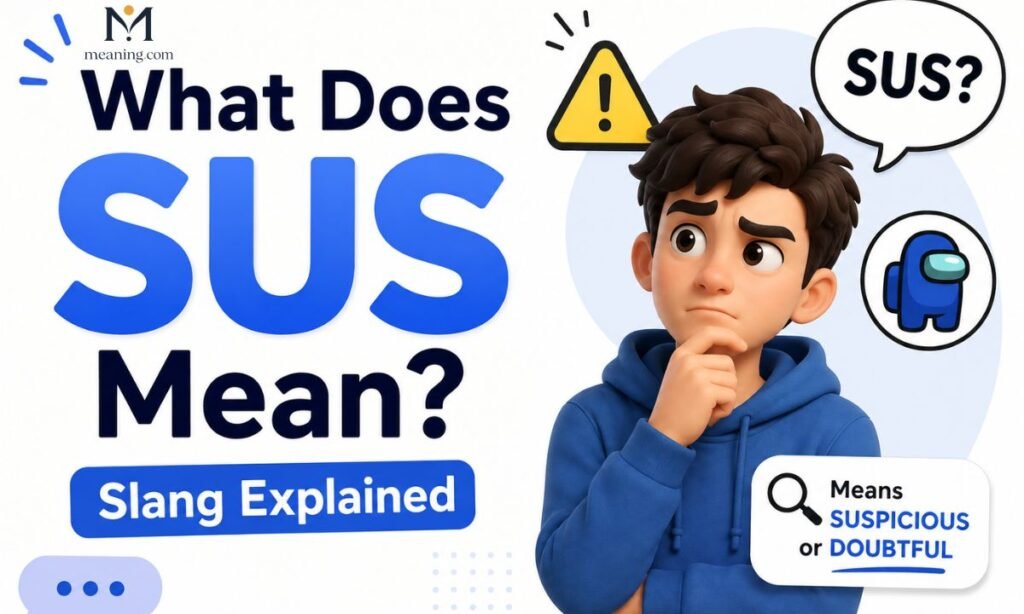
If you have teenagers at home, spend time on TikTok, or play online games, you have probably heard the word “sus” thrown around. Maybe a friend called your excuse “sus,” or you saw it pop up in a group chat and had no idea what it meant. You are not alone.
“Sus” is one of the most widely used slang terms today, especially among Gen Z. It shows up in texts, comments, memes, and everyday conversation. But where did it come from, and what does it actually mean? This guide breaks down the definition, origin, and correct usage of “sus,” so you never have to guess again.
What Does Sus Mean?

“Sus” is a shortened form of the word “suspicious” or “suspect.” It is used to describe a person, situation, or behavior that seems questionable, shady, or untrustworthy.
When someone says a person is “acting sus,” they mean that person is behaving in a way that raises doubt. It could suggest the person is lying, hiding something, or simply acting out of character.
Here is a simple breakdown:
| Term | Meaning |
| Sus (adjective) | Suspicious or suspect |
| Sus (noun) | A suspicious person or a suspicion itself |
| Slightly sus | A little bit suspicious, not fully confirmed |
| Mad sus / Hella sus | Extremely suspicious |
Unlike some slang words that carry multiple unrelated meanings, “sus” stays fairly consistent. Whether it is used online or in person, it almost always points back to distrust or doubt.
Origin and History of “Sus”
Many people assume “sus” is a brand new word created for the internet, but that is not accurate. Its roots go back much further than most realize.
Early Origins
Language records show that “sus” and its variant spelling “suss” were used as far back as the 1920s and 1930s in British slang, referring to a suspected person or a suspicion. By the mid-1900s, “sus” was already appearing in dictionaries as an adjective meaning suspicious or suspected.
In British English, the related verb “suss out” has been common since the 1960s. It means to figure something out or investigate a situation, as in “let me suss out what’s going on.”
The Modern Revival
So why does “sus” feel like a brand new word? The answer is gaming culture.
Around 2019 and 2020, the online multiplayer game Among Us exploded in popularity. In the game, players work together on a spaceship while one or more hidden “imposters” try to secretly eliminate the crew. During in-game discussions, players would accuse each other of being the imposter by calling their behavior “sus.”
That single word became the game’s signature phrase. Streamers, YouTubers, and millions of players repeated it constantly, and it quickly spilled over into everyday texting, social media captions, and real-life conversations. What started as old slang got a massive second life through gaming culture, and it has stuck around ever since.
How “Sus” Is Used on Different Platforms
“Sus” shows up differently depending on where you see it. Here is a quick platform-by-platform look.
TikTok and Instagram
On TikTok and Instagram, “sus” is often used in captions, comments, and trending audio to call out something that looks off, whether it is a plot twist in a video, an awkward moment, or a questionable outfit choice.
Gaming Chats
In games like Among Us, Fortnite, or Valorant, “sus” is used to accuse a teammate or opponent of suspicious behavior, such as standing still too long, avoiding tasks, or acting nervous during a round.
Text Messages and Group Chats
In texting, “sus” is used casually to react to a friend’s story, excuse, or plan. A simple “that’s sus” can replace a whole sentence of doubt.
Twitter/X and Reddit
On these platforms, “sus” often appears in reaction to news, screenshots, or unusual claims, used almost like a one-word fact-check.
Sus in Texting vs. Real Life

While the core meaning of “sus” does not change, how it is used can shift slightly depending on whether you are texting or talking face-to-face.
| Context | Typical Use | Example |
| Texting | Quick, casual reaction, often standalone | “That’s sus.” |
| Real life | Spoken with tone or sarcasm, often paired with a laugh | “Okay, that’s kind of sus, ngl.” |
| Gaming | Direct accusation during gameplay | “You’re sus, you didn’t do your tasks.” |
| Social media | Used to comment on content or trends | “This video is sus, something’s edited.” |
In texting, “sus” is often typed alone or with minimal punctuation, letting the tone come across as blunt or teasing. In real life, tone of voice does a lot of the work. It can sound playful among friends or genuinely doubtful in a more serious conversation.
Examples of “Sus” in Sentences
Seeing “sus” used in context makes it much easier to understand. Here are some everyday examples:
- “He said he was busy all weekend, but his sus story doesn’t add up.”
- “Why is the Wi-Fi suddenly working perfectly? That’s sus.”
- “She’s been acting sus ever since she borrowed my charger and never gave it back.”
- “That email asking for your password looks sus, don’t click it.”
- “You’re being kind of sus right now, are you hiding something?”
- “The price on that listing seems sus, probably a scam.”
Notice that “sus” fits naturally into casual sentences without needing extra explanation. It works as a quick, efficient way to flag doubt.
Variations and Related Slang
Slang rarely stays in one fixed form, and “sus” has picked up a few common variations and close relatives.
- Sussy – A playful, exaggerated version of “sus,” often used in a joking tone.
- Sus AF – An intensified version meaning “extremely suspicious.”
- Slightly sus / a little sus – Used to soften the accusation, implying mild suspicion rather than certainty.
- Suss out – The older British phrase meaning to investigate or figure something out.
- Shady – A close cousin of “sus,” describing behavior that feels dishonest or secretive.
- Sketchy – Similar meaning, often used for places or situations rather than people.
While these words overlap in meaning, “sus” tends to feel more casual and internet-native, while “shady” and “sketchy” existed independently of gaming and social media culture.
Is “Sus” Safe for Kids?
For the most part, yes. “Sus” is generally considered mild, harmless slang. It is not a curse word, and using it does not typically signal anything inappropriate.
That said, there are a few things parents and educators might want to keep in mind:
- Context matters. Kids sometimes use “sus” as a lighthearted accusation during games or jokes, which is completely normal.
- Watch for misuse. In rare cases, slang terms get stretched to describe someone’s appearance or identity in a way that could feel mocking. If a child uses “sus” to target another person unfairly, it is worth having a conversation about kindness and intent.
- It is a good conversation starter. Asking your child what “sus” means to them can open the door to talking about online trends, gaming culture, and digital communication in general.
Overall, “sus” ranks low on the list of concerning slang terms. It is more about vocabulary trends than anything harmful.
When to Use (and Avoid) “Sus”

Like most slang, “sus” fits some settings better than others.
Good times to use “sus”:
- Texting friends or family casually
- Reacting to something surprising or questionable online
- Playing games with friends
- Light, joking conversations
Times to avoid “sus”:
- Formal writing, such as school essays, resumes, or business emails
- Professional conversations or workplace communication
- Situations where precise, formal language is expected
If you are unsure whether “sus” fits the moment, a simple rule works well: if you would use other casual slang like “lowkey” or “no cap” in that setting, “sus” probably fits too. If not, stick with “suspicious” instead.
Frequently Asked Questions
What does “sus” mean in texting?
It means suspicious or questionable, used to react to something that seems untrustworthy or off.
Does “sus” come from Among Us?
No, the word existed long before the game, but Among Us made it popular again starting around 2019 to 2020.
Is “sus” a bad word?
No, it is considered mild slang and is generally appropriate for casual conversation.
What does “sussy” mean?
It is a playful, exaggerated version of “sus,” often used jokingly rather than seriously.
Can adults use “sus” too?
Yes, plenty of adults use it casually, especially in texting or online conversations.
What is the opposite of “sus”?
Words like “legit,” “trustworthy,” or “genuine” work as opposites, describing something believable rather than suspicious.
Conclusion
“Sus” may feel like a brand new internet word, but its roots stretch back nearly a century. What started as old British slang for suspicious behavior found new life through gaming culture, particularly Among Us, and quickly became a staple of modern texting and social media language.
At its core, “sus” simply means suspicious or questionable, whether describing a person, a story, or a strange situation. It is casual, easy to use, and generally harmless, making it a natural fit for everyday conversation, though it is best saved for informal settings rather than professional writing.
Now that you know exactly what “sus” means, where it came from, and how to use it correctly, you will never be left confused the next time it shows up in your group chat.

Ethan Brooks is a content creator and SEO professional with 5 years of experience in search engine optimization, content writing, and website growth. I’m passionate about creating helpful, easy-to-understand content that provides real value to readers and performs well in search engines.