


Few three-letter acronyms carry as many completely unrelated meanings as PSA. Depending on where you encounter it, PSA could be a heads-up in a group chat, a government document from the Philippines, a number on a medical lab report, or an airline you’ve never heard of. This guide breaks down every major meaning so you know exactly which one applies.
Meaning & Definition of PSA
At its core, PSA is an abbreviation used across completely separate fields — internet slang, government administration, medicine, and aviation — with no shared history between them. The correct meaning is entirely determined by context.
PSA meaning birth certificate
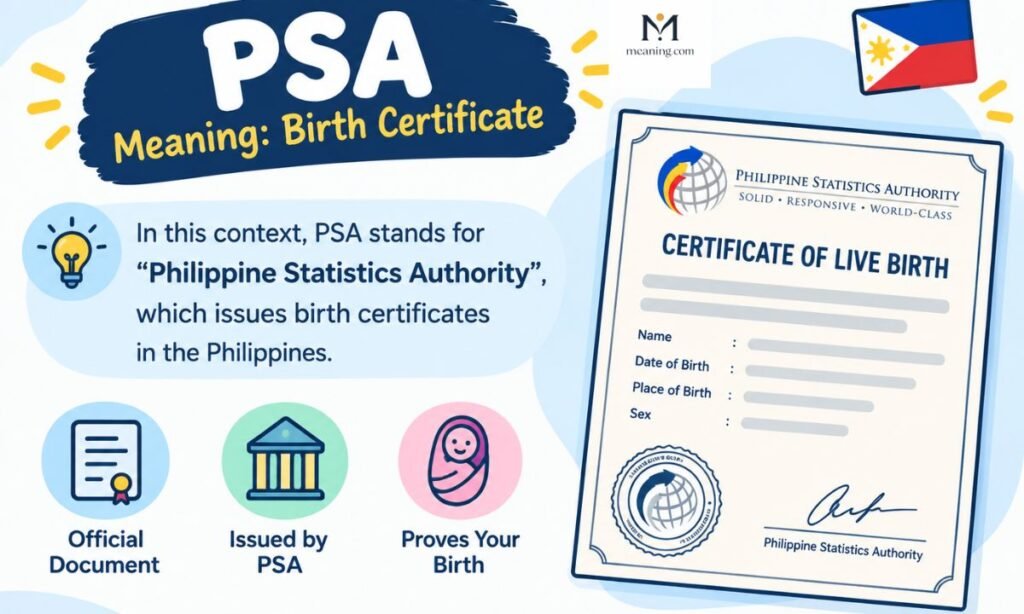
In the Philippines, “PSA” refers to the Philippine Statistics Authority, the government agency responsible for issuing official civil registry documents — birth certificates, marriage certificates, death certificates, and CENOMAR (Certificate of No Marriage Record). A “PSA birth certificate” is the standard, government-certified copy of someone’s birth record, printed on secure paper and commonly required for passports, school enrollment, employment, and other legal transactions.
Public Service Announcement
In everyday English, PSA most often stands for Public Service Announcement — a short message intended to inform or warn the public about something useful, whether that’s traffic safety, public health, or, in casual online use, a lighthearted heads-up among friends.
Examples:
- Formal: “This PSA reminds residents to boil tap water until further notice.”
- Casual: “PSA: the coffee machine on the third floor is broken again.”
PSA meaning medical
In healthcare, PSA generally refers to Prostate-Specific Antigen, a protein produced by the prostate gland. It’s measured through a blood test used primarily to screen for prostate conditions.
PSA meaning cancer
The PSA blood test is closely tied to prostate cancer screening. It measures the level of prostate-specific antigen in the blood, reported in nanograms per milliliter (ng/mL); higher levels have historically been associated with advanced prostate cancer. That said, PSA is an organ-specific marker rather than a cancer-specific one — it can also rise due to non-cancerous conditions like benign prostatic hyperplasia (an enlarged prostate) or prostatitis (inflammation of the prostate). Because of this, an elevated PSA prompts further evaluation rather than serving as a diagnosis on its own.
Aviation Meaning
In aviation, PSA Airlines is a U.S. regional airline that operates flights on behalf of a major carrier under a connection/express branding arrangement, flying smaller regional jets to connect passengers to larger hub airports.
Gaming / Internet Slang
In gaming chats and online forums, “PSA” is frequently borrowed from its formal “Public Service Announcement” meaning but used more loosely and often with humor — flagging a bug, a patch note, a scam warning, or just an amusing observation the poster wants to share with the community.
Background & Origin of PSA

The “Public Service Announcement” meaning dates back to broadcast media, where short, non-commercial messages were aired on radio and television for public benefit — think safety campaigns and civic reminders. As internet culture absorbed broadcast-era language, “PSA” carried over into forums, group chats, and social media as a way to flag information as worth everyone’s attention, often used half-seriously.
The medical meaning developed on a completely separate track: PSA as a lab marker became part of clinical practice once the blood test was developed and later approved for screening use, and its use in the acronym has nothing to do with the “announcement” sense.
The Philippine Statistics Authority is a government body with its own separate institutional history, and PSA Airlines is a named aviation brand — both are simply organizations that happen to share the same three initials.
Usage in Different Contexts
In Chats & Messaging Apps
In everyday messaging, “PSA” almost always signals the sender is about to share information the group should know — sometimes genuinely useful, sometimes just a lightly self-aware way of announcing something small.
On Social Media
On social platforms, PSA is a common lead-in for posts meant to inform or warn followers — a reminder, a correction, or a heads-up about something trending, often written in the same tone as a real public service message even when the content is casual.
Professional Use
In professional or organizational communication, PSA usually keeps its formal meaning — an official notice meant for broad internal or public distribution, such as a safety reminder or policy update.
PSA Meanings Across Platforms
PSA meaning text
In text messages, PSA functions as shorthand for “just so everyone knows” — introducing a piece of information the sender thinks matters to the recipient or group.
In WhatsApp group chats, PSA is commonly used to flag important shared information — plans, reminders, or updates relevant to everyone in the group.
On Instagram, PSA often appears in captions or Stories to introduce something the poster wants followers to pay attention to, ranging from genuinely important updates to playful observations.
TikTok
On TikTok, “PSA” is a popular framing device for videos — creators use it to signal that a video is meant to inform, warn, or correct a misconception, which fits neatly into short-form, direct-to-camera content.
Snapchat
On Snapchat, usage mirrors general chat and social media — a quick “PSA” heads-up shared with friends or a Snap Story.
PSA test normal range
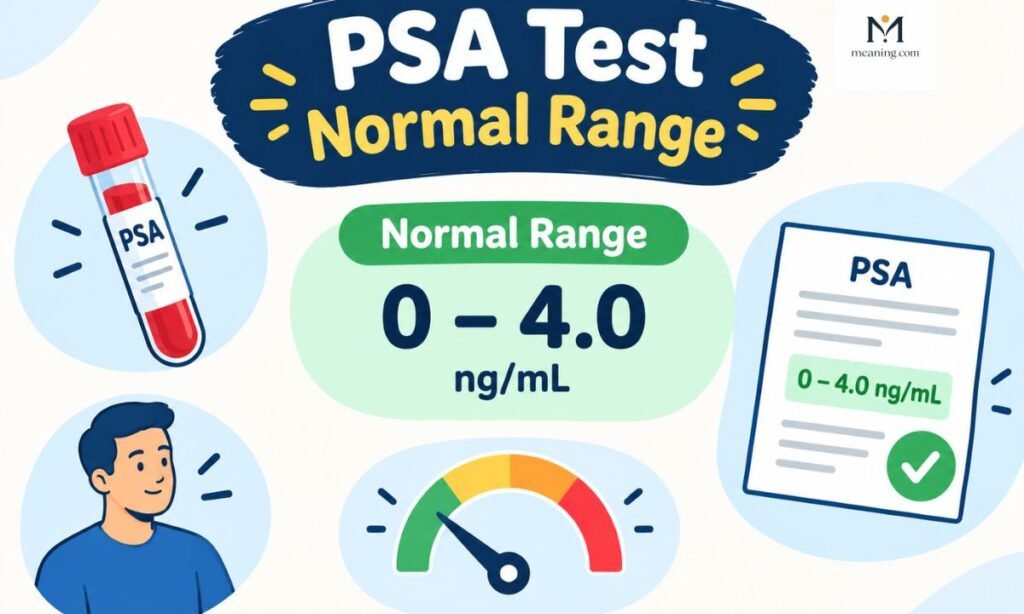
Medically, what counts as a “normal” PSA reading varies by age and by the specific guideline used, since there’s no single universal cutoff. A commonly cited scale puts 3 ng/mL or less as normal for a man under 60, 4 ng/mL or less as normal for ages 60 to 69, and 5 ng/mL or less as normal for men over 70. Some guidelines simplify this to a single threshold of around 3 ng/mL for all ages instead of using age-based bands. Because reference ranges differ between labs and guidelines, results are best interpreted by the ordering physician rather than compared against a single fixed number.
Medical Field
Beyond prostate screening, “PSA” is specifically used in urology and oncology as shorthand in lab reports, referral letters, and treatment monitoring — tracking a patient’s PSA over time (known as “PSA velocity”) can be as clinically relevant as a single reading.
Aviation
Within the airline industry, PSA Airlines operates as a regional carrier, and industry professionals use “PSA” as shorthand for the airline itself in scheduling, staffing, and operational contexts.
Science & Technical Use
In scientific and technical writing outside medicine, “PSA” can also stand for unrelated terms specific to a given field (for example, certain chemistry and engineering contexts use it for entirely different processes or compounds). As with any acronym, technical documents typically spell out the intended meaning on first use.
Common Misconceptions & Mistakes
Common mistake example:
A frequent mix-up is assuming every online “PSA” is meant seriously. Because the term originated in official public messaging, some readers take a casual “PSA: the vending machine is out of order” as more urgent than intended. Context and tone — not just the acronym — usually make clear whether it’s a genuine warning or a lighthearted aside. On the medical side, a common misconception is treating a single elevated PSA reading as a cancer diagnosis; in reality, an elevated result is a prompt for further testing, not a confirmed finding on its own.
Similar Terms & Alternatives
In casual chat, PSA sits alongside other “heads-up” phrasing like “FYI” (for your information), “reminder,” and “heads up” itself. In healthcare, it’s discussed alongside other prostate-related terms like DRE (digital rectal exam) and the Prostate Health Index (PHI), which combine with PSA results for a fuller clinical picture.
How to Respond to PSA
Examples:
- Casual chat: If a friend posts “PSA: happy hour ends at 7 today,” a simple “thanks for the heads up!” is all that’s needed.
- Social media: Responding to an informative PSA post usually means engaging with the content itself — asking a follow-up question or sharing it further if it’s genuinely useful.
- Medical context: If a PSA result is mentioned by a doctor or in a report, the appropriate response is to ask the healthcare provider directly about what the specific number means for your situation, since interpretation depends on personal history and other factors a general guide can’t account for.
Differences From Similar Words
What is a dangerous PSA level
There’s no single number that universally marks a PSA reading as “dangerous,” but clinical research offers useful reference points. PSA levels between 4.0 and 10.0 ng/mL are linked to roughly a 25 percent chance of prostate cancer (they can also reflect benign prostatic hyperplasia), while levels above 10 ng/mL are linked to roughly a 50 percent chance, which is why they typically prompt further testing. Even values below the traditional 4.0 cutoff aren’t automatically risk-free — large screening studies have found prostate cancer in men with PSA as low as 0.5 ng/mL, and men with baseline readings between 1.5 and 4.0 ng/mL have shown meaningfully higher long-term prostate cancer rates than those below 1.5 ng/mL. Because of this, a “dangerous” PSA level is really a matter of degree and trend evaluated by a doctor, not a fixed line — this is general information, not a substitute for medical advice, so any specific result should be discussed with a healthcare provider.
PSA vs Announcement
A generic “announcement” can be about anything, including promotional or unimportant news. A PSA, by tradition, implies the content is meant to genuinely inform or protect the audience — even when used loosely online.
PSA vs Alert
An “alert” typically implies urgency or a need for immediate action (like a weather alert), while a PSA is usually informational and rarely time-critical, even when it’s important.
PSA in Online Conversations & Dating Apps

In DMs and dating app conversations, “PSA” is occasionally used the same way as in general chat — flagging something the other person should know, from a scheduling conflict to a lighthearted personal update. It’s a low-key way to signal “this is worth reading” without sounding overly formal.
Popularity & Trends Over Time
The formal “Public Service Announcement” meaning has stayed consistent for decades, rooted in broadcast and government communication. Its casual, ironic use in chat and social media has grown alongside short-form content platforms, where framing a post as a “PSA” is an easy way to make it feel more shareable. The medical and institutional meanings (PSA testing, the Philippine Statistics Authority, PSA Airlines) remain stable and unrelated to these trends, since they’re tied to fixed institutions and clinical practice rather than internet culture.
Frequently Asked Questions
What is the meaning of PSA in text?
In everyday texting, PSA usually means “Public Service Announcement” — a casual way of flagging information the sender thinks the recipient or group should know.
What is a PSA short for?
Depending on context, PSA can stand for Public Service Announcement (general/slang), Prostate-Specific Antigen (medical), Philippine Statistics Authority (government/civil documents), or PSA Airlines (aviation).
What is the meaning of PSA in social media?
On social media, PSA typically introduces a post meant to inform, warn, or correct followers about something — ranging from serious to lighthearted depending on the account and tone.
What is a normal PSA range?
General reference ranges are 3 ng/mL or less for men under 60, 4 ng/mL or less for ages 60–69, and 5 ng/mL or less for men over 70, though exact thresholds vary by lab and guideline — a doctor should interpret any individual result.
Conclusion
PSA is really four (or more) unrelated acronyms sharing the same three letters: a casual or formal heads-up in everyday language, a government authority behind civil documents in the Philippines, a widely used cancer-screening blood marker in medicine, and a named regional airline in aviation. Context — who’s saying it, and where — is the only reliable way to know which one you’re looking at.
This article is for general informational purposes and isn’t medical advice. If you have questions about a PSA test result, talk to a doctor or healthcare provider.

Ethan Brooks is a content creator and SEO professional with 5 years of experience in search engine optimization, content writing, and website growth. I’m passionate about creating helpful, easy-to-understand content that provides real value to readers and performs well in search engines.