

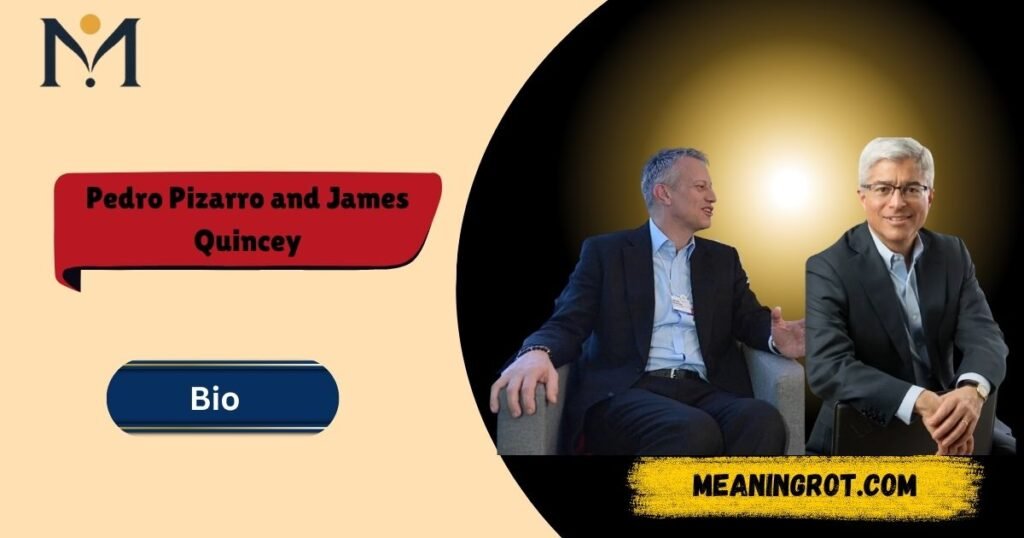
Pedro Pizarro and James Quincey run very different companies, yet both steered household names through crises.
Quincey served nine years as Coca-Cola’s CEO before becoming executive chairman in 2026.
Pizarro has led Edison International, parent of Southern California Edison, since 2016. This guide covers their biographies, net worth, earnings, leadership styles, and what comes next.
| Detail | James Quincey | Pedro Pizarro |
| Full Name | James Robert B. Quincey | Pedro J. Pizarro |
| Age (2026) | 61 | 60 (per 2026 proxy) |
| Birthplace | London, England | Not publicly detailed |
| Nationality | British | American executive |
| Profession | Executive Chairman, The Coca-Cola Company | President and CEO, Edison International |
| Height | Not publicly disclosed | Not publicly disclosed |
| Weight | Not publicly disclosed | Not publicly disclosed |
| Net Worth | Not officially disclosed; reported stock holdings above $30 million (2024) | Not officially disclosed; reported Edison stake near $22 million |
Pedro Pizarro and James Quincey: Biography, Net Worth & Business Success in 2026
Both executives are company lifers who rose from within. Quincey joined Coca-Cola in 1996 and became CEO in 2017. Pizarro joined Edison in 1999 and became CEO in 2016. Their industries differ, but each leader faced crises that tested investors and customers.
Neither man’s wealth is formally disclosed. Therefore, this article relies on SEC filings, company releases, and reported holdings.
Pedro Pizarro and James Quincey at a Glance
Quincey now chairs Coca-Cola, which reported $47.9 billion in 2025 net revenues. Pizarro remains CEO of an Edison International that guides to 2026 core earnings of $5.90 to $6.20 per share. Meanwhile, one leads a consumer brand sold worldwide, and the other runs a regulated utility serving Southern California.
James Quincey: Leading a Global Consumer Brand
James Quincey Biography: From Career Insider to CEO
Born in London in 1965, Quincey earned an electronic engineering degree at the University of Liverpool, according to public profiles. He worked in consulting before joining Coca-Cola. He served as COO from 2015 to 2017, became CEO in 2017, and was named chairman in 2019.
The “Total Beverage Company” Strategy
Quincey pushed Coca-Cola beyond soda into water, sports drinks, coffee, dairy, and juice. Acquisitions such as Costa Coffee, fairlife, and BODYARMOR widened the portfolio. The company says it added more than 10 billion-dollar brands during his tenure.
Case Study: Cutting the Brand List to Grow Faster
In 2020, reports said Coca-Cola would cut roughly half of its 400 brands, including Tab and Zico. The goal was focus: fewer labels, bigger bets. That discipline helped, as Coca-Cola Zero Sugar grew 14% in 2025.
Pedro Pizarro and James Quincey Net Worth: The Coke Side
Quincey’s exact net worth is not publicly confirmed. However, insider-trading data showed he owned about 442,500 Coca-Cola shares worth over $30 million in 2024. Online estimates vary widely and remain unverified. His income comes mainly from salary, incentives, and stock awards.
The 2026 Handoff
On March 31, 2026, Henrique Braun, a 29-year company veteran, became CEO. Quincey stayed on as executive chairman. Additionally, an SEC filing set Braun’s base salary at $1.45 million with a 200% target bonus.
Coca-Cola’s Financial Scorecard Under Quincey
| 2025 Metric | Result |
| Net revenues | $47.9 billion (+2%) |
| Organic revenues | +5% |
| Reported EPS | $3.04 (+23%) |
| Comparable EPS | $3.00 (+4%) |
| Free cash flow | $5.3 billion |
Coca-Cola’s stock climbed nearly 63% during his CEO tenure, according to Reuters. For 2026, the company expects 4% to 5% organic revenue growth.
Digital Transformation and Business Adaptation
Steering Through the Pandemic
In 2020, restaurants, theaters, and stadiums closed, hitting Coca-Cola’s away-from-home sales. According to company filings, revenue fell about 11% that year. Quincey responded with cost cuts, brand pruning, and a faster shift to retail and e-commerce. Revenue rebounded in 2021.
Data, Dispensers, and AI Marketing
Coca-Cola leaned on consumer data, app-enabled Freestyle dispensers, and AI-assisted campaigns. The company also created a Chief Digital Officer role. Braun has said expanded use of technology will be a priority.
Case Study: Learning From a Mixed Reaction
Coca-Cola’s AI-generated holiday ad drew online criticism in late 2024 for looking artificial. Supporters called it an efficient creative experiment. The lesson is practical: technology can cut costs, but audiences still judge emotional authenticity.
Sustainability in the Beverage Industry
The Packaging Goals Reset
In December 2024, Coca-Cola replaced older targets with 2035 goals. It now aims for 35% to 40% recycled material in primary packaging, down from a prior 50% target for 2030. It also dropped its 25% reusable packaging goal.
Where Coke Held Firm
Water goals stayed strong. Coca-Cola kept its pledge to return more than 100% of the water used in finished products and expanded replenishment targets to 200 high-risk locations by 2035.
Why It Matters
Critics said the reset exposed the limits of voluntary pledges. Reusable packaging was only 1.2% of its plastic packaging in 2023. Supporters argue realistic targets beat missed promises. For shoppers, recycling infrastructure, not marketing, will decide results.
Pedro Pizarro: Guiding an Energy Transformation
Pedro Pizarro Biography: Scientist Turned Utility Chief
Pizarro holds a chemistry degree from Harvard and a Ph.D. in chemistry from Caltech. He worked at McKinsey, joined Edison in 1999, led Edison Mission Energy, ran SCE from 2014, and became Edison International’s CEO in 2016.
Pedro Pizarro and James Quincey Net Worth: The Edison Side
Pizarro’s net worth is not officially disclosed. Market-data sites reported 2024 compensation near $13.8 million, mostly stock-based, and a direct stake worth about $22 million. He also chaired the Edison Electric Institute starting in 2023 and sits on the 3M board.
Edison’s Financial Snapshot
| Measure | Figure |
| Q2 2026 core EPS | $1.54 (vs. $0.97) |
| 2026 core EPS guidance | $5.90 to $6.20 |
| Long-term growth target | 5% to 7% through 2030 |
| Capital plan, 2026 to 2030 | $38 to $41 billion |
Pizarro said Edison can execute its plan through 2028 without new equity.
Modernizing the Electric Grid
Hardening Against Wildfire
SCE reported about 93% of physical hardening work in high fire risk areas complete by April 2026. Pizarro also said it has seen no covered conductor failure tied to the risks that technology targets.
Case Study: The Eaton Fire Response
After the January 2025 Eaton Fire, SCE launched a voluntary compensation program. By mid-2026 it had extended more than 2,200 offers totaling over $775 million, yet management said it still lacked enough data to estimate the low end of liability. SCE also revised its filing to say its equipment was likely associated with the fire.
Permitting: The Hidden Bottleneck
Grid projects often stall in permitting long before construction. Pizarro said Edison is applying data analytics and AI to grid planning, permit processing, and risk identification. Faster approvals matter because delays raise what customers eventually pay.
Clean Energy and Electrification
What Electrification Means for You
More electric vehicles, heat pumps, and appliances will raise household power demand. Edison points to transportation electrification and commercial growth, with near-term load growth of 1% to 3%.
The Data Center Wave
Many utilities lean on data centers for growth. Edison said in October 2025 that its plan does not count on large data center contributions, projecting 7% to 8% rate base growth through 2028. It now guides to roughly 7% annually through 2030.
Affordability
Pizarro notes that SCE’s system average rates sit 20% below other major California utilities. Still, wildfire costs could push bills up. He warned that weak legislation could trigger credit downgrades and higher financing costs.
Two Industries, Similar Leadership Challenges for Pedro Pizarro and James Quincey
Side-by-Side Comparison
| Category | Quincey | Pizarro |
| Company | Coca-Cola (KO) | Edison International (EIX) |
| Role | Executive Chairman | President and CEO |
| Joined | 1996 | 1999 |
| Training | Engineering | Chemistry, Ph.D. |
| 2026 theme | CEO handoff | Wildfire liability and reform |
Shared Challenges
Pedro Pizarro and James Quincey both manage reputational risk, regulation, and long investment cycles. Each faces pressure to balance shareholder returns with public expectations on climate. Additionally, each must keep trust when things go wrong, whether that is a recycling pledge or a wildfire.
A Key Difference
Coca-Cola sells discretionary products and can cut brands or reprice. Edison is a regulated utility, so rates, spending, and cost recovery need government approval. Therefore, Quincey’s levers are mostly market-driven, while Pizarro’s depend heavily on regulators and legislators.
Leadership Through Change
Quincey’s Style: Reinvent and Hand Off
Quincey reshaped the portfolio, then planned his succession. Coca-Cola’s board credited him with developing and empowering the next set of leaders.
Pizarro’s Style: Engineer the Problem
Trained as a scientist, Pizarro frames challenges in technical terms: hardening hardware, modeling risk, and tracking metrics. His earnings calls lean on completion percentages and program data, which suggests an engineering mindset.
Leadership Lessons You Can Use
First, prune before you grow. Second, build your successor early. Third, measure risk in numbers and share them. Finally, admit limits openly when facts are incomplete.
Case Study: Two Ways to Handle Criticism
Quincey faced backlash over packaging goals and responded by extending timelines and calling the targets realistic. Pizarro faced scrutiny over Eaton Fire disclosures and responded with a compensation program and revised filing language. One defended strategy, while the other prioritized recovery.
The Future of Their Industries
What Comes Next for Beverages
Under Braun, Coca-Cola targets steady organic growth. Expect continued focus on Zero Sugar, emerging markets, and technology, with Quincey advising from the chair.
What Comes Next for Energy
Edison expects 5% to 7% core EPS growth through 2030. That outlook hinges on California wildfire legislation, which Pizarro says could change financing costs.
What to Watch in Late 2026 and 2027
Watch Edison’s third-quarter results, California’s wildfire reform, and Eaton Fire settlement data. For Coca-Cola, watch Braun’s first full-year plan and further packaging progress.
Conclusion: James Quincey and Pedro Pizarro
The careers of Pedro Pizarro and James Quincey show two playbooks for leading through change.
Quincey simplified a sprawling brand list, expanded into new drinks, and handed the CEO role to a successor.
Pizarro, meanwhile, is hardening California’s grid while managing wildfire liability. Their net worth, earnings, and influence tie directly to those choices.
FAQs
Who is the CEO of Coca-Cola in 2026?
Henrique Braun became CEO on March 31, 2026, succeeding James Quincey, who is now executive chairman.
What is James Quincey’s net worth?
It is not officially disclosed. Public estimates suggest his Coca-Cola stock alone was worth over $30 million in 2024.
Is Pedro Pizarro still CEO of Edison International?
Yes. He has served as President and CEO since 2016, and he led the company’s second-quarter 2026 earnings call.
How much does Pedro Pizarro earn?
Reported total compensation was about $13.8 million for 2024, with roughly 10% as salary.
What do Pedro Pizarro and James Quincey have in common?
Both are long-tenured insiders who led major U.S. companies through crises, from the pandemic to wildfire liability.

Ethan Brooks is a content creator and SEO professional with 5 years of experience in search engine optimization, content writing, and website growth. I’m passionate about creating helpful, easy-to-understand content that provides real value to readers and performs well in search engines.
6 thoughts on “Pedro Pizarro and James Quincey: Careers, Net Worth & Success”