

If you’ve spotted “BTA” in a group chat, a comment section, or even a work email, you’ve probably paused to wonder what it actually means. The honest answer is: it depends entirely on where you saw it. BTA is one of those rare abbreviations that has picked up genuinely different meanings across casual texting, gaming, business, and finance — with almost no overlap between them. This guide walks through every major use so you can figure out which one applies to you.
Meaning & Definition of BTA
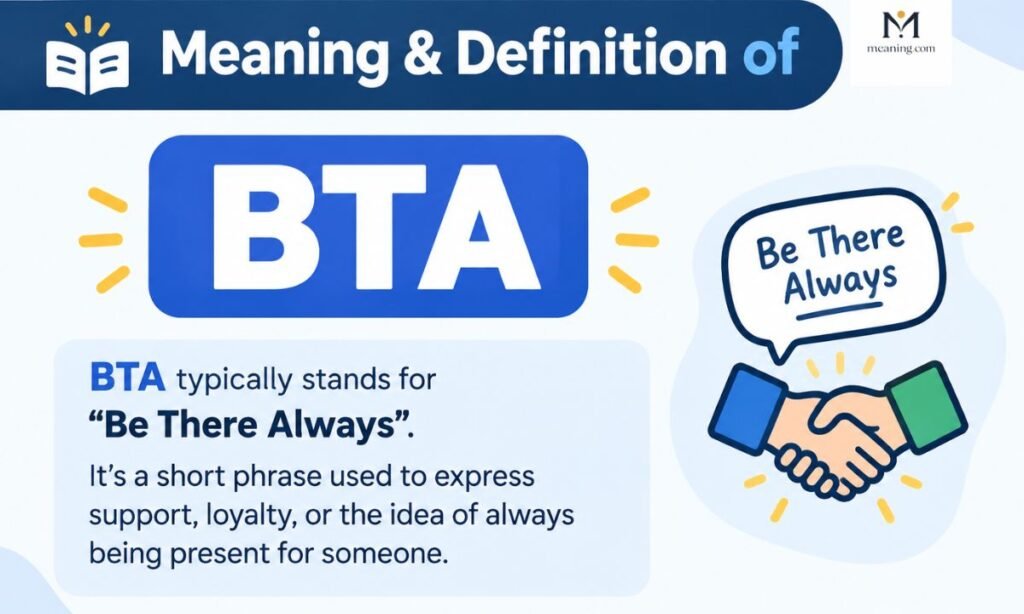
In its most widespread casual sense, BTA stands for “Better Than Average.” It’s used as a quick, informal rating — something is good, solid, or a notch above expectations, without necessarily being the best thing out there.
Outside of slang, BTA is also a live acronym in business and finance (most often “Business Travel Allowance” or a related insurance term), and it shows up occasionally in gaming shorthand and regional texting styles. There is no single official body that “owns” the term, so its meaning is entirely context-driven.
Common meanings include:
- Better Than Average (casual/social slang — the most common online use)
- Business Travel Allowance (workplace/HR)
- Business Travel Accident (insurance policies)
- A stand-in for “be right back”-style availability shorthand in some gaming and group-chat circles
- In some South Asian texting communities, a phonetic stretch of “batao” (Hindi/Urdu for “tell me”), though this is regional and not universal
Example:
- Casual: “That new coffee shop was BTA, not gonna lie.”
- Work: “Please submit your BTA reimbursement form by Friday.”
Background & Origin of BTA
Like most modern internet acronyms, BTA doesn’t trace back to one clean origin story. The slang sense grew the way abbreviations like LOL, BRB, and IMO did: as texting and forum culture favored short, fast phrases over full sentences, “better than average” got compressed for speed. It likely circulated first in gaming chats, forums, and comment sections before spreading to Instagram captions and TikTok replies.
Separately, and much earlier, “BTA” existed as a formal shorthand in business and insurance paperwork — long before it had any life as internet slang. That’s why the professional and casual meanings feel so disconnected: they essentially developed on separate tracks.
Usage of BTA in Different Contexts
Chat & Messaging
In everyday texting, BTA is almost always the casual compliment: a way of saying something (or someone) is solid, impressive, or above average. It’s typically upbeat and low-effort — closer to a quick nod of approval than a detailed compliment.
Gaming
In gaming chats, BTA can be used the same way as in general texting — rating a player’s skill or a match as “better than average.” Some gaming groups also use it as informal shorthand tied to timing or readiness (e.g., letting teammates know you’re stepping away and will rejoin shortly), though this usage is far less standardized and varies a lot by community. If a term like “BTA meaning basketball” comes up, it’s almost always the same “better than average” idea applied to a player or performance — not a league-specific term.
Professional Use
In offices and HR communication, BTA usually refers to Business Travel Allowance — a set amount or policy covering expenses employees incur while traveling for work. In email threads, this is the meaning to assume unless context clearly points to something casual.
Social Media
On platforms like Instagram, TikTok, and Twitter/X, BTA tends to appear in comments and captions as a quick, casual seal of approval — “this fit is BTA,” “that take was BTA.” It’s part of a broader family of short reaction-acronyms (similar in spirit to “fr,” “ngl,” or “lowkey”).
Meanings Across Platforms
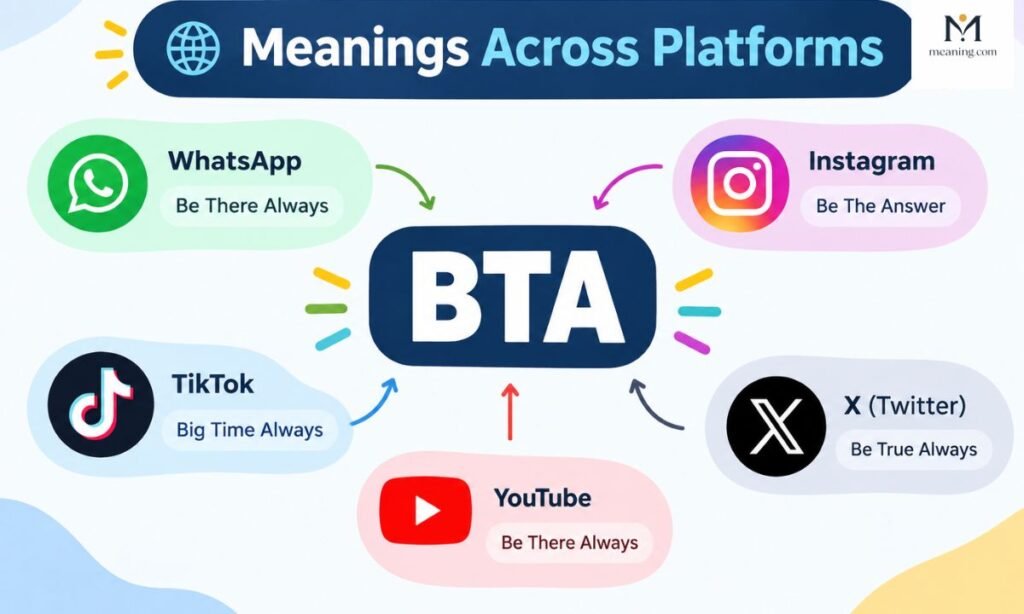
In WhatsApp chats, especially in mixed-language or regional group chats, BTA can occasionally be used as informal phonetic shorthand rather than a true acronym. In most general use, though, it still lands on “better than average.”
On Instagram, BTA shows up mostly in comments as a quick compliment on a photo, outfit, or post — functionally identical to the general slang meaning.
Bta meaning TikTok
On TikTok, BTA is used the same way as elsewhere in casual chat: a fast, positive rating in comment sections (“this recipe is BTA”). Because TikTok comment culture moves quickly and favors short reactions, this is one of the platforms where the term shows up most often.
BTA meaning snapchat
On Snapchat, usage mirrors general texting slang — a quick “better than average” comment on a snap, story, or plan. There’s no Snapchat-specific meaning beyond that.
Other Fields Where BTA Is Used
Banking & Finance
In financial and banking contexts, BTA has been used as shorthand tied to travel-related insurance products (Business Travel Accident coverage) offered as an employee benefit. It’s worth noting this is a completely different lineage from the slang sense — there’s no crossover.
Business
In general business writing, BTA most commonly points back to Business Travel Allowance: a policy-level term describing what a company will cover for employee travel.
Insurance/Reports
In insurance documentation, BTA typically appears as part of “Business Travel Accident” insurance — a policy type covering employees against accidents while traveling on company business.
Technical Communication
Outside of chat slang, BTA also turns up as an organizational or technical abbreviation in specific industries (for example, various trade associations and aviation-related shorthand use “BTA” for their own unrelated full forms). These are niche and won’t come up in everyday conversation.
BTA meaning finance
In finance-specific discussions, if BTA isn’t referring to a travel allowance or accident policy, check for a company- or industry-specific expansion — some finance and trade contexts use BTA as shorthand for a named agreement or account type. When in doubt, the surrounding paragraph will usually spell it out on first use, which is standard practice for acronyms in formal writing.
Common Misconceptions & Mistakes
Common mistake:
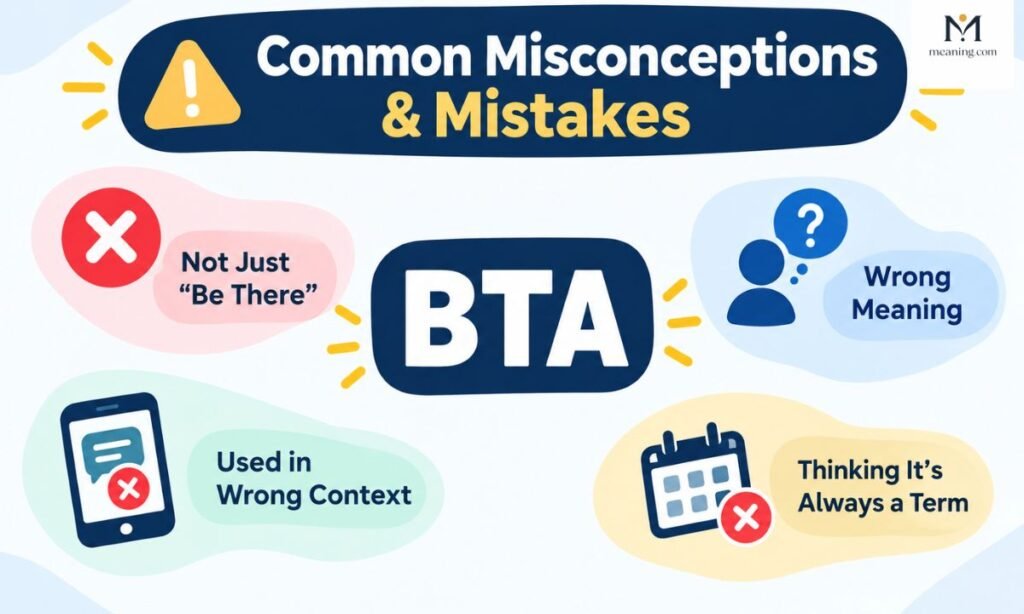
The biggest mix-up is bringing the casual “better than average” meaning into a professional setting, where BTA almost always means something related to business travel. Firing off “that report was BTA!” in a corporate email risks being read as an unrelated benefits question. The safest rule: match the register of the conversation. Casual chat and social comments — assume slang. Anything HR, insurance, or finance-adjacent — assume the formal meaning.
Similar Terms & Alternatives
BTA sits alongside a family of short approval or reaction acronyms used in similar ways: “fr” (for real), “ngl” (not gonna lie), “lowkey/highkey,” and “W” (a win). None of these are interchangeable in exact meaning, but they occupy the same casual, quick-reaction space in texting and comments.
How to Respond to BTA
Friendly chat examples:
- If someone says “your playlist is BTA,” a simple “thanks, glad you liked it” or “appreciate that!” works fine.
- If you’re unsure which meaning was intended, it’s completely normal to ask — “BTA as in better than average? 😄”
Professional context:
- If a colleague or HR message uses BTA, respond in kind assuming the travel-allowance meaning unless told otherwise — e.g., “Got it, I’ll submit my BTA form by Friday.”
Bta meaning medical
BTA is not a standard, widely recognized medical abbreviation, and medical shorthand varies significantly by specialty and institution. If you’ve encountered “BTA” in a medical document or from a healthcare provider, the safest move is to ask the provider or check the specific institution’s documentation directly, rather than relying on a general definition.
Differences From Similar Words
It’s easy to confuse BTA with visually similar acronyms:
- BTW = “By The Way” (adding extra information), not related to BTA at all.
- BTO = “Build To Order,” common in manufacturing and retail — unrelated to BTA.
- BBA = “Bachelor of Business Administration,” an academic degree, not slang.
Keeping these apart mostly comes down to context: BTA is a rating or a travel-related business term, while these others serve entirely different functions.
Relevance in Online Conversations & Dating Apps
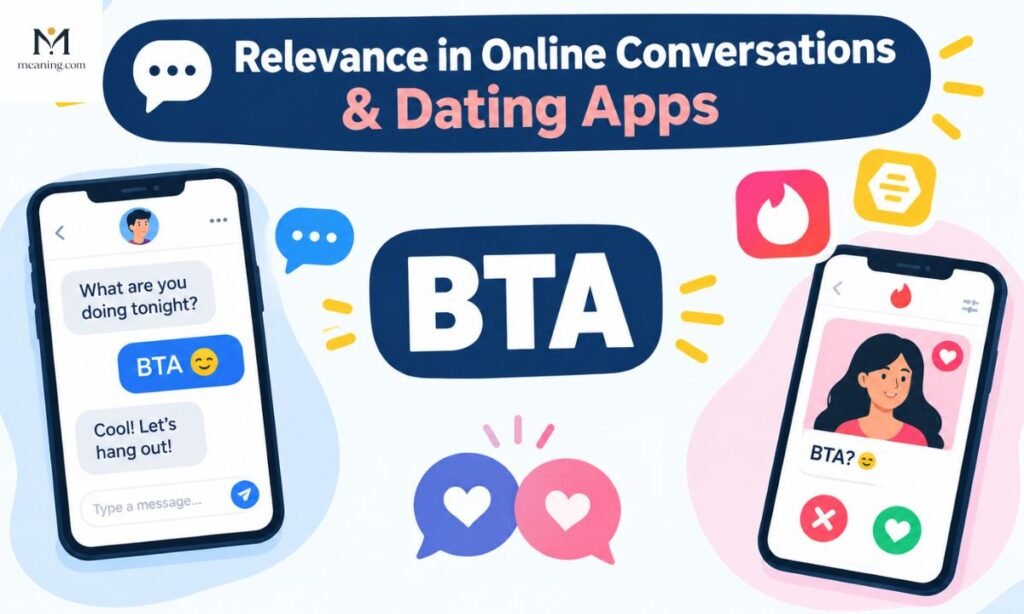
On dating apps and in DMs, BTA generally keeps its casual meaning — a quick, positive read on someone’s profile, photo, or message (“your bio is BTA”). As with general chat, it’s a low-stakes compliment rather than a strong declaration, so it’s usually read as friendly rather than deeply meaningful.
Popularity & Trends Over Time
BTA isn’t a brand-new term, but its casual “better than average” usage has become more visible recently as short-reaction culture (driven by comment sections on TikTok and Instagram) has pushed more abbreviations into everyday use. Its professional meaning, by contrast, has stayed stable and niche for far longer, tied to corporate travel policy language rather than trends.
Frequently Asked Questions
What does bta mean in slang?
Most commonly, “Better Than Average” — a casual way of saying something is solid or a bit above the norm.
What does “BTA” mean in texting?
In general texting, it’s almost always the same casual “better than average” meaning. Regional or group-specific alternate meanings do exist, so context matters.
What is BTA full form?
There isn’t one single full form. Depending on context it can expand to “Better Than Average” (slang), “Business Travel Allowance” (HR/business), or “Business Travel Accident” (insurance), among other niche, industry-specific expansions.
What does “BTA” mean on Instagram?
On Instagram, it’s used the same way as general chat slang — a quick, positive comment meaning something is better than average.
Conclusion
BTA is a genuinely split-personality acronym: casual and complimentary in chat and social media, formal and travel-related in business and insurance paperwork. There’s no universal rulebook, so the fastest way to decode it is to look at where you found it — a comment section points to “better than average,” while an HR email points to travel allowances or accident coverage. When it’s still unclear, it never hurts to just ask.

Ethan Brooks is a content creator and SEO professional with 5 years of experience in search engine optimization, content writing, and website growth. I’m passionate about creating helpful, easy-to-understand content that provides real value to readers and performs well in search engines.