

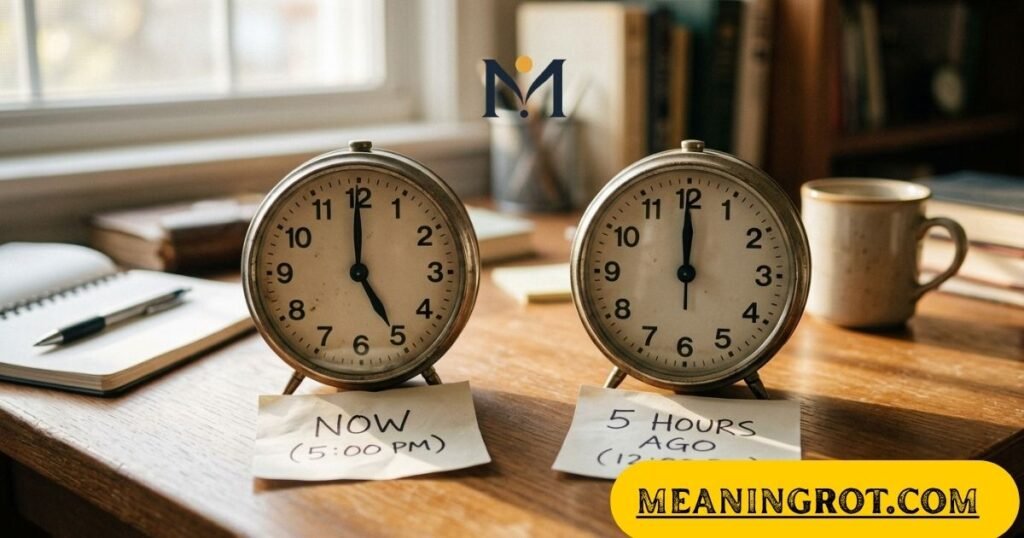
Need to know what time was it 5 hours ago right now? The answer takes seconds. Subtract 5 hours from your current clock time and adjust for AM, PM, and the date if needed.
This guide shows the quick rule, a ready chart, time zone tips, and daylight saving time facts for 2026. You will also see common mistakes and five short FAQs.
Quick Answer: What Time Was It 5 Hours Ago?
Take your current time and go back 5 hours. That is your answer.
- 3:00 PM now means it was 10:00 AM five hours ago.
- 11:00 AM now means it was 6:00 AM five hours ago.
- 2:00 AM now means it was 9:00 PM the day before.
The rule changes only when you cross noon or midnight. Then AM and PM flip, and the date may change too.
Profile Summary Table
| Detail | Info |
| Topic | Finding the time 5 hours ago |
| Core formula | Current time minus 5 hours |
| Time units | 5 hours = 300 minutes = 18,000 seconds |
| Clock types | 12 hour (AM/PM) and 24 hour |
| Biggest risk | Crossing midnight or noon |
| Time zone factor | Always use the zone you need |
| DST factor | Can shift the answer by 1 hour |
| Best tools | Phone clock, world clock, time calculator |
| Difficulty | Easy |
How to Calculate 5 Hours Ago Step by Step
You do not need a calculator. A few simple steps are enough.
Method for a 12 Hour Clock
- Write down the current time with AM or PM.
- Subtract 5 from the hour number.
- If the result is 1 or higher, keep the same AM or PM.
- If the result is 0 or below, add 12 to the hour.
- Flip AM to PM, or PM to AM.
- If you crossed midnight, move the date back one day.
Example: it is 3:00 AM. Subtract 5 and you get negative 2. Add 12 and you get 10. Flip AM to PM. The answer is 10:00 PM yesterday.
Method for a 24 Hour Clock
The 24 hour clock is easier because there is no AM or PM.
- Subtract 5 from the hour.
- If the result is below 0, add 24.
- Move the date back one day.
Example: it is 02:00. Subtract 5 and you get negative 3. Add 24 and you get 21:00 on the previous day.
A Mental Shortcut
Picture a clock face. Go back 6 hours, which is half the dial. Then move forward 1 hour. At 3:00 PM, half a dial back is 9:00 AM. Add one hour and you get 10:00 AM.
5 Hours Ago Chart for Quick Lookup
Find your current time in the chart and read the answer.
| Current Time (AM) | 5 Hours Ago | Current Time (PM) | 5 Hours Ago |
| 1:00 AM | 8:00 PM (yesterday) | 1:00 PM | 8:00 AM |
| 2:00 AM | 9:00 PM (yesterday) | 2:00 PM | 9:00 AM |
| 3:00 AM | 10:00 PM (yesterday) | 3:00 PM | 10:00 AM |
| 4:00 AM | 11:00 PM (yesterday) | 4:00 PM | 11:00 AM |
| 5:00 AM | 12:00 AM (midnight) | 5:00 PM | 12:00 PM (noon) |
| 6:00 AM | 1:00 AM | 6:00 PM | 1:00 PM |
| 7:00 AM | 2:00 AM | 7:00 PM | 2:00 PM |
| 8:00 AM | 3:00 AM | 8:00 PM | 3:00 PM |
| 9:00 AM | 4:00 AM | 9:00 PM | 4:00 PM |
| 10:00 AM | 5:00 AM | 10:00 PM | 5:00 PM |
| 11:00 AM | 6:00 AM | 11:00 PM | 6:00 PM |
| 12:00 PM (noon) | 7:00 AM | 12:00 AM (midnight) | 7:00 PM (yesterday) |
Minutes stay the same. If it is 4:47 PM, five hours ago was 11:47 AM.
Worked Examples You Can Copy
These real life cases cover the most common questions.
- Evening check: It is 8:30 PM. Five hours ago was 3:30 PM.
- Early morning check: It is 1:15 AM. Five hours ago was 8:15 PM on the previous day.
- Noon check: It is 12:00 PM. Five hours ago was 7:00 AM.
- Midnight check: It is 12:00 AM. Five hours ago was 7:00 PM the day before.
- Military time: It is 18:40. Five hours ago was 13:40.
5 Hours Ago in Different Time Zones
A time zone decides which clock you should read. First pick the zone. Then subtract 5 hours inside that same zone.
If you need the time in a different zone, convert first. Use the UTC offset to do it.
| Time Zone | UTC Offset |
| UTC / GMT | UTC plus 0 |
| Eastern Standard Time (EST) | UTC minus 5 |
| Eastern Daylight Time (EDT) | UTC minus 4 |
| Central Standard Time (CST) | UTC minus 6 |
| Pacific Standard Time (PST) | UTC minus 8 |
| Central European Time (CET) | UTC plus 1 |
| India Standard Time (IST) | UTC plus 5:30 |
| Pakistan Standard Time (PKT) | UTC plus 5 |
| Japan Standard Time (JST) | UTC plus 9 |
Example: it is 10:00 AM in New York during EST. Five hours ago was 5:00 AM in New York. In London that same moment was 10:00 AM, because London is 5 hours ahead of EST.
Simple tip: convert to UTC first. Subtract 5 hours. Then convert back to the zone you need.
Daylight Saving Time and the 5 Hour Rule
Daylight saving time, also called DST, is where most mistakes happen. Clocks jump forward or back by one hour. That can change the answer.
Here are the 2026 dates to remember.
- Europe: clocks go back on Sunday, October 25, 2026.
- United States: clocks go back on Sunday, November 1, 2026, at 2:00 AM.
- Countries that do not use DST keep the same offset all year.
Why does this matter? A clock reading and real elapsed time can differ on that night.
Example: it is 4:00 AM EST on November 1, 2026. If you only subtract 5 hours, you get 11:00 PM. But five real hours ago was 12:00 AM EDT, because one hour repeated overnight.
Away from the change date, simple subtraction works fine.
Why Knowing the Time 5 Hours Ago Helps
People use this calculation more than they think.
- Work logs: Track when a task or shift started.
- Medicine timing: Check when a dose was taken, then confirm with your label or doctor.
- Travel: Match flight, train, or delivery times.
- Meetings: Find a slot that fits teammates in other zones.
- Online orders: Understand when a package scan or payment happened.
- Security checks: Review login or device activity times.
- Sleep tracking: Count hours since you woke up or went to bed.
Common Mistakes to Avoid
Small slips cause wrong answers. Watch for these.
- Forgetting to flip AM and PM after crossing noon or midnight.
- Ignoring the date. Five hours before 2:00 AM is on the previous day.
- Mixing time zones. Use one zone from start to finish.
- Skipping DST. Check if a clock change falls inside your 5 hour window.
- Using the wrong base time. Always start from the exact current time, not a rounded one.
Easy Tools to Check the Answer
You can confirm your math in seconds.
- Phone world clock: Add the zone and compare the hour.
- Search engine: Type your zone with the time you need.
- Time calculator: Enter the current time and subtract 5 hours.
- Spreadsheet: Subtract 5 divided by 24 from a time cell.
Use two methods when the result matters, such as for legal, medical, or travel records.
Expert Tips for Accurate Results
Good habits make this simple.
- Write times in 24 hour format when logging events. It removes AM and PM confusion.
- Store records in UTC when you work with global teams.
- Add the date next to every time you note down.
- Double check around DST change weekends.
- Treat any online result as a guide, and verify it against your own device clock.
These tips follow standard time keeping practice used by schedulers, travelers, and support teams.
Conclusion
Finding what time was it 5 hours ago is simple once you know the rule. Subtract 5 from the current hour. Flip AM and PM when you cross noon or midnight. Move the date back when you pass midnight.
Always pick the right time zone first. In late October and early November 2026, watch the clock changes in Europe and the United States.
Keep the chart handy and use the 24 hour clock for fewer errors. With these steps you can answer this question in seconds, any time of day.
Frequently Asked Questions
How do I quickly find the time 5 hours ago?
Subtract 5 from the current hour and flip AM or PM if you cross noon or midnight. For example, 3:00 PM becomes 10:00 AM.
What time was it 5 hours ago if it is 2:00 AM now?
It was 9:00 PM on the previous day. You cross midnight, so the date moves back by one.
Does daylight saving time change the answer?
Yes, if a clock change falls inside the 5 hour window. On those nights the clock reading can differ by one hour from real elapsed time.
How many minutes and seconds are in 5 hours?
Five hours equal 300 minutes or 18,000 seconds. This helps when you convert times in logs or timers.
Is 5 hours ago the same in every time zone?
No. The method is the same, but the clock reading depends on each zone’s UTC offset. Always pick your zone first.

Ethan Brooks is a content creator and SEO professional with 5 years of experience in search engine optimization, content writing, and website growth. I’m passionate about creating helpful, easy-to-understand content that provides real value to readers and performs well in search engines.