


If you’ve seen someone reply “cap” or “no cap” to a story online and felt slightly confused, you’re not the only one. This small word has become one of the most widely used slang terms in casual conversation, especially among younger generations. This guide breaks down exactly what cap means, where it came from, and how it’s used across chats, social media, and even outside of slang entirely.
1. Meaning & Definition of Cap
In modern slang, “cap” means a lie or an exaggeration. Saying something is “cap” means you don’t believe it, or you think the person is stretching the truth. The opposite phrase, “no cap,” means someone is being completely honest and serious.
- Cap = a lie, a false claim, or an exaggeration
- No cap = no lie, for real, genuinely true
- Capping = the act of lying or exaggerating
Example: “She said she ran a marathon in two hours, that’s cap.” Here, cap signals disbelief in the claim being made.
2. Background & Origin of Cap
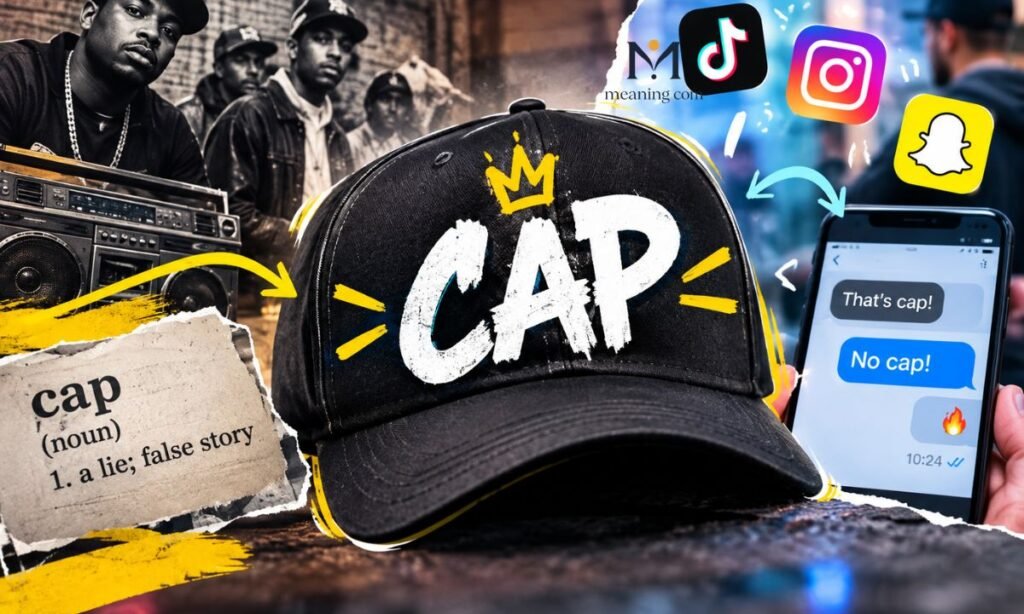
Cap comes from African American Vernacular English (AAVE) and has roots that stretch back much further than most people realize. Linguists have traced early versions of “capping” to the early 1900s, where it referred to bragging, exaggerating, or outdoing someone in a boastful way. This connects to a much older oral tradition known as “playing the dozens,” a game of exchanging exaggerated insults, which some researchers link directly to the roots of “cap.”
The phrase gained mainstream traction through hip hop, with references to “cap” and “no cap” appearing in songs dating back decades before exploding into wider pop culture in the late 2010s. By the time social media picked it up, cap had already been part of Black cultural vocabulary for generations, and it’s worth acknowledging that history whenever the term is used.
3. Usage in Different Contexts
Cap meaning in english
In everyday English conversation, cap simply functions as a call-out for dishonesty. It’s short, casual, and often used to challenge a claim without sounding overly serious or confrontational.
1. Social Media
On platforms like TikTok and X, cap is often used in comments to challenge a post’s claim, such as a wild story, a bold prediction, or a suspicious flex. “No cap” is also used constantly in captions to emphasize sincerity.
2. Chat Conversations
In texts and DMs, cap is used casually to question something a friend just said: “wait that’s cap” or to confirm something is true: “I got the job, no cap.”
3. Entertainment & Memes
Memes frequently use cap to mock exaggerated claims, whether it’s a celebrity statement, a movie plot hole, or an obviously staged video. It’s become a quick, universally understood way to signal skepticism online.
4. Professional Tone (rare)
Cap almost never appears in formal or professional writing. It’s considered casual slang, so it’s typically avoided in emails, reports, or workplace communication unless the tone is intentionally informal.
Cap meaning lie
At its core, this is the simplest definition: cap means lie. If someone says “stop capping,” they’re telling you to stop lying or exaggerating.
4. Meanings Across Platforms
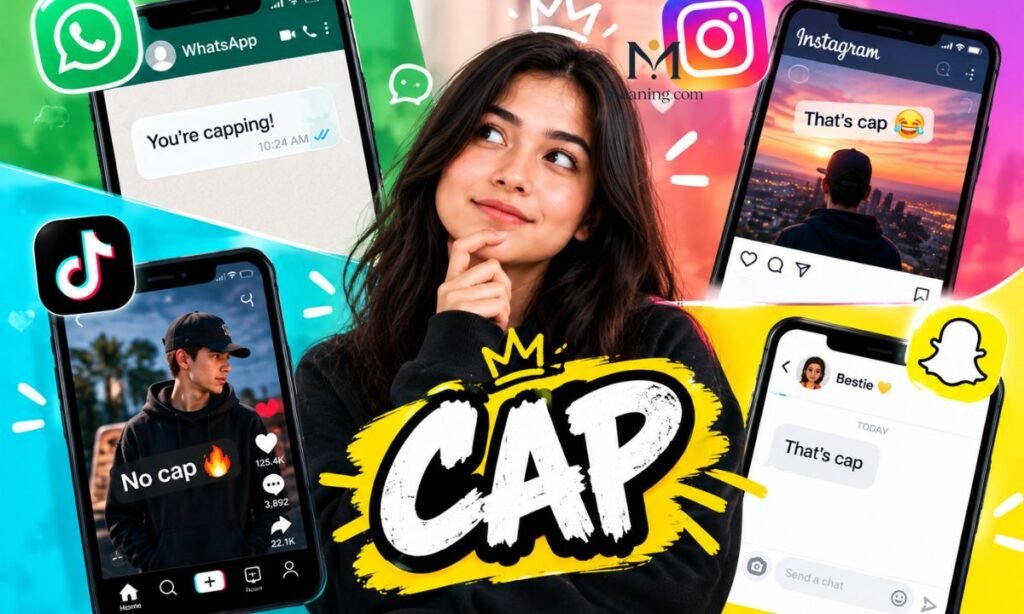
| Platform | Common Usage |
| Used casually in one-on-one or group chats to question a claim | |
| Common in comments under bold captions or flex posts | |
| TikTok | Widely used in comments and duets to call out exaggerated content |
| Snapchat | Used in quick captions or chat replies to react to a claim |
On WhatsApp, cap usually shows up in personal conversations, often as a short, playful way to challenge something a friend just claimed.
Instagram comment sections frequently use cap to react to flashy posts, questioning whether a claim about money, achievements, or relationships is genuine.
TikTok
TikTok is where cap sees the heaviest daily use, particularly in comment sections reacting to storytime videos, prank videos, or bold on-screen claims.
Snapchat
On Snapchat, cap tends to appear in short captions reacting to a Snap, keeping with the platform’s quick, informal tone.
5. Other Fields Meanings
Outside of slang, “cap” carries several unrelated meanings depending on the field:
- General English: a head covering, or a limit placed on something (a spending cap, a salary cap)
- Finance: short for “market capitalization,” referring to a company’s total value
- Sports: an appearance for a national team, as in “he earned his first international cap”
- Manufacturing: a protective covering placed over the top of a container, bottle, or component
- CAP meaning medical: in healthcare, CAP most commonly stands for Community-Acquired Pneumonia, a type of lung infection acquired outside of a hospital setting
6. Common Misconceptions & Mistakes
- Assuming cap always refers to a literal hat rather than the slang meaning
- Confusing “cap” and “no cap” and using them backwards
- Using cap in professional or formal writing where it doesn’t fit the tone
- Believing the slang term originated on TikTok, when it actually has decades of history rooted in AAVE and hip hop culture
7. Similar Terms & Alternatives
- Lying or exaggerating – standard English equivalents
- For real (FR) – similar to “no cap,” used to emphasize honesty
- Sus – suspicious, often used alongside cap when questioning a claim
- Fake – a more general term for something dishonest or staged
- CAP meaning medical – Community-Acquired Pneumonia, unrelated to the slang usage entirely
8. How to Respond to “Cap”
Responding to cap usually means either defending your claim or admitting you were exaggerating.
- “That’s cap” → “No I swear, it actually happened”
- “No cap?” → “No cap, I promise”
- “You’re capping” → “Fine, maybe I exaggerated a little”
9. Differences From Similar Words
Cap specifically implies dishonesty or exaggeration, while similar-sounding or related terms carry different shades of meaning:
- Cap vs Sus: Cap means something is a lie, while sus means something seems suspicious or questionable, not necessarily false
- Cap vs Fake: Fake can describe an object or persona, while cap is almost always used to describe a spoken or written claim
- Cap vs Exaggeration: Exaggeration is the formal English term, while cap is the casual, slang equivalent used mostly in speech and text
10. Relevance in Online Conversations & Dating Apps

On dating apps, cap is often used playfully to challenge a bold claim in a bio or opening message, such as someone listing impressive hobbies or achievements. It adds a lighthearted, teasing tone rather than a serious accusation.
Examples:
- Replying to a bio that says “world traveler, 30 countries” with “no cap?”
- “You said you can cook, no cap?”
- “That story you just told me sounds like cap, but I’ll allow it”
11. Popularity & Trends Over Time
Cap and no cap moved from AAVE and hip hop lyrics into mainstream slang gradually, gaining major traction in the late 2010s as social media accelerated the spread of Black cultural vocabulary into everyday youth language. Unlike many slang trends that fade quickly, cap has remained consistently popular, largely because it’s short, versatile, and fills a communication gap that older phrases like “for real” or “I’m serious” don’t quite capture in the same casual tone. It continues to show up heavily across comment sections, captions, and everyday texting well into 2026.
Frequently Asked Questions
What does cap mean in slang?
Cap means a lie or an exaggeration, while no cap means someone is telling the truth.
What does “cap it” mean in slang?
“Cap it” or “capping” refers to the act of lying or exaggerating about something.
What is the full meaning of cap?
Cap doesn’t stand for an acronym in slang, it simply means lie, with roots in AAVE and hip hop culture.
What is the meaning of cap in medical terms?
In medical contexts, CAP typically stands for Community-Acquired Pneumonia, a lung infection contracted outside of a hospital.
Conclusion
Cap has grown from a term rooted in African American Vernacular English and hip hop culture into one of the most recognizable slang words used across texting and social media today. Whether you’re seeing it in a TikTok comment, a group chat, or a dating app message, understanding both its meaning and its origin helps you use it accurately and respectfully in everyday conversation.

Ethan Brooks is a content creator and SEO professional with 5 years of experience in search engine optimization, content writing, and website growth. I’m passionate about creating helpful, easy-to-understand content that provides real value to readers and performs well in search engines.