


Scroll through TikTok, Instagram, or even a group chat for five minutes and you’ll almost certainly spot the letters “POV.” It shows up in captions, comments, memes, and casual conversation, often without any explanation. If you’ve ever paused mid scroll wondering what it actually means or why it’s suddenly everywhere, this guide covers it all: the definition, the history, and exactly how people use it across every major platform in 2026.
Meaning & Definition of POV
Primary Meaning:
POV stands for Point of View. In its original sense, borrowed from literature, film, and photography, it refers to the perspective from which a story, scene, or experience is presented. A first-person POV shows events through one character’s eyes, while a third-person POV describes the action from an outside observer’s vantage point.
Secondary Meaning (Internet Use):
Online, POV has taken on a broader, more playful meaning. Instead of describing narrative technique, it now introduces a scenario and invites the viewer to imagine themselves inside it. A caption like “POV: you’re the last one picked for the team” isn’t describing a camera angle. It’s setting up a relatable or exaggerated situation for the audience to experience as if it were happening to them.
Examples:
- “POV: it’s Monday morning and your alarm didn’t go off.”
- “POV: you just got home and the wifi is down.”
- “In my POV shot, the camera moves exactly where the character looks.”
- “That’s just my POV on the whole situation.”
Background & Origin of POV
Traditional Use:
Long before social media, POV was standard terminology in filmmaking, photography, and creative writing. A “POV shot” in cinema places the camera in the position of a character’s eyes, letting the audience see what that character sees. In literature, POV determines whether a story is told in first person, second person, or third person, shaping how readers connect with events.
Digital Evolution:
As smartphones made point-of-view style filming accessible to everyone, the term migrated from professional film sets to everyday video content. Instead of describing complex camera work, “POV” became shorthand for any video shot from the creator’s own perspective. From there, it evolved further. Creators began using the word not just to describe filming style, but to frame an entire scenario for the viewer to imagine, whether or not the video was shot in a literal first-person angle. That shift is what turned POV into one of the internet’s most recognizable content formats.
Usage in Different Contexts
1. Social Media Content
On platforms built around short video, POV is now a content format in its own right. Creators use it to set up comedic skits, relatable daily moments, or dramatic roleplay scenarios, letting the caption do the storytelling instead of dialogue.
2. Chat Conversations
In texts and DMs, POV is often used more loosely, introducing an opinion or a personal take: “POV: this is the best pizza place in town.” Here it functions almost like “IMO” (in my opinion), adding a bit of narrative flair to a simple statement.
3. Storytelling & Memes
Meme culture has leaned heavily into POV as a formula. A single image or short clip paired with a POV caption can turn an everyday moment into something instantly shareable, because it invites the reader to project themselves into the scene.
4. Gaming Community
Gamers frequently use POV to describe gameplay footage recorded from a player’s own screen or perspective, distinguishing it from spectator or third-person recordings. It’s also used to reference a specific player’s viewpoint during a match replay or highlight clip.
Meanings Across Platforms (WhatsApp, Instagram, TikTok, Snapchat)
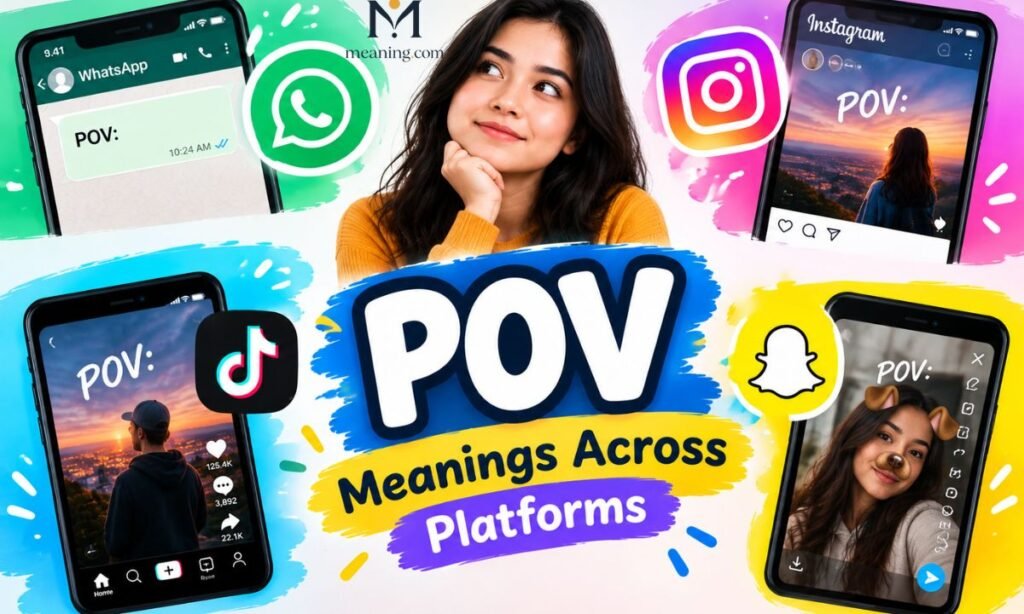
| Platform | Common Usage |
| Used in personal chats to share an opinion or reaction, often shortened and casual | |
| Common in captions and Reels to frame a relatable scenario or aesthetic moment | |
| TikTok | The dominant format for skits, roleplay, and storytelling videos |
| Snapchat | Used in captions on Snaps to set up a quick situational joke or reaction |
On WhatsApp, POV tends to appear in text form rather than video, often introducing a personal take on a shared photo or story within a chat.
Instagram users lean on POV heavily in Reels and carousel captions, often combining it with trending audio to build a scenario the audience can relate to instantly.
TikTok
TikTok is where the modern POV format truly took off. Entire genres of content, from comedic skits to emotional storytelling, are built around a single POV caption that frames the whole video.
Snapchat
On Snapchat, POV is typically used in quick, low-effort captions, matching the platform’s fast, informal communication style.
Other Fields Where POV is Used
Film & Photography
In these fields, POV remains a precise technical term describing a camera angle that mimics a character’s literal line of sight, used to build immersion or tension in a scene.
Psychology
POV can also refer more broadly to an individual’s subjective perspective or mindset when processing a situation, a concept used in discussions of empathy, bias, and perception.
Automotive & Aviation
In vehicle testing, racing footage, and flight training, POV cameras are mounted to capture footage from the driver’s or pilot’s seat, providing a first-person record of the experience for review or analysis.
Science & Technical Fields
Researchers sometimes use POV loosely to describe the frame of reference from which data, an experiment, or an observation is recorded, distinguishing it from a third-party or instrument-based viewpoint.
Common Misconceptions & Mistakes

Common Mistakes:
- Assuming POV always means the video is filmed from a literal first-person camera angle
- Using “my POV” and “your POV” interchangeably without adjusting the sentence structure
- Treating POV captions as a technical film term when they’re functioning as a storytelling format instead
Misconception:
Many assume a POV video must be shot handheld or from an actual first-person camera position. In reality, most social media POV content is filmed conventionally. The caption itself does the work of putting the viewer “in the scene,” regardless of camera angle.
✔ Correct Usage:
A properly used POV caption sets up a specific, relatable scenario in second person, letting the viewer mentally step into the role being described, rather than describing an opinion the creator holds about themselves.
Similar Terms & Alternatives
- IMO / IMHO – In My Opinion / In My Humble Opinion
- FPP – First-Person Perspective, a more technical term used in gaming and film
- TBH – To Be Honest, often used alongside a personal take
- IRL – In Real Life, sometimes paired with POV to ground a scenario
- Roleplay caption – a broader term for the storytelling format POV videos often follow
How to Respond to POV in Chats
Responding to a POV message usually means engaging with the scenario or opinion being presented rather than questioning the acronym itself.
Examples:
- “POV: you’re stuck in traffic and already late” → “honestly this is too real”
- “POV: best coffee shop in the city” → “adding this to my list”
- “that’s just my POV” → “fair, I see it differently though”
Differences From Similar Words
POV vs Opinion:
An opinion is a direct statement of belief (“I think this movie is great”). POV frames that same idea as a perspective or scenario, often inviting the audience to imagine experiencing it themselves rather than simply reading a claim.
POV vs Story:
A story typically has a beginning, middle, and end with some narrative development. A POV caption is usually a single frozen moment or scenario, designed to be understood instantly rather than unfold over time.
POV vs Caption:
A caption is the broader category, any text accompanying a photo or video. POV is a specific type of caption that frames content from a defined perspective, rather than simply describing or labeling what’s shown.
Relevance in Online Conversations & Dating Apps

Why it’s used:
POV has become a popular way to add personality and humor to profiles, bios, and conversation starters. It signals a lighthearted, in-the-know communication style and often invites the other person to react or engage rather than just read passively.
Examples:
- A dating profile bio: “POV: you finally found someone who also hates small talk.”
- Opening a chat with: “POV: we matched and now I have to think of something clever to say.”
- Reacting to a match’s photo: “pov this is exactly my type of trip.”
Popularity & Trends Over Time
Trend Timeline:
POV moved from a niche film and photography term into mainstream internet vocabulary as short-form video platforms grew. Early usage stuck closely to its literal, first-person camera meaning. As the format matured, creators stretched it into a flexible storytelling tool, and it eventually crossed over into everyday texting and casual conversation, well beyond video content.
Why it stays popular:
- It’s short, easy to type, and instantly recognizable
- It works as both a technical term and a casual, flexible format
- It invites engagement by putting the audience directly into a scenario
- It adapts easily across memes, captions, gaming, and everyday chat
Frequently Asked Questions
What is a pov in social media?
On social media, POV is a caption style that frames a video or post as a specific scenario, letting viewers imagine experiencing it themselves.
What is pov in gen z?
For Gen Z, POV is commonly used both in video captions and everyday texting to introduce a relatable situation or a strongly held opinion.
How do you use pov?
Start with “POV:” followed by a second-person scenario or perspective, such as “POV: you just missed the bus by ten seconds.”
Why does everyone say pov now?
It’s a quick, familiar way to frame relatable content and invite engagement, which is why it spread from video captions into everyday conversation.
Conclusion
POV started as a precise term in film and literature and has grown into one of the most flexible tools in online communication. Whether it’s describing an actual first-person camera shot, framing a relatable meme, or simply introducing a personal opinion, POV works because it puts the audience directly into the moment. Understanding its different meanings, from the technical to the casual, makes it easier to use naturally and read correctly wherever you come across it.

Ethan Brooks is a content creator and SEO professional with 5 years of experience in search engine optimization, content writing, and website growth. I’m passionate about creating helpful, easy-to-understand content that provides real value to readers and performs well in search engines.