

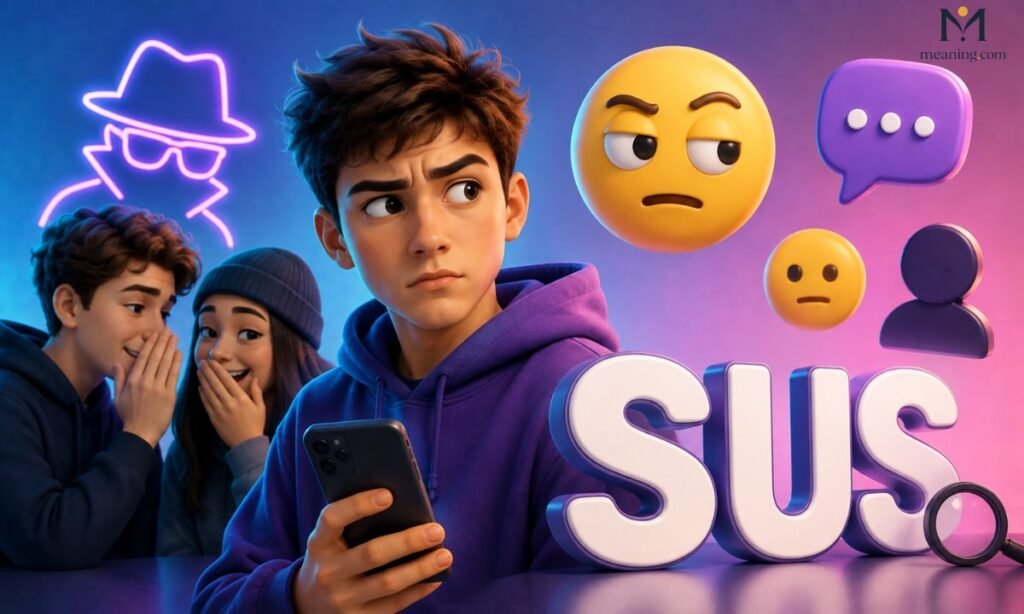
Somebody gives a shaky excuse for being late, and within seconds someone in the group chat drops a single word back: “sus.” No explanation needed, no follow-up required — everyone already knows what’s being implied. If you’ve caught yourself nodding along without actually knowing the word’s backstory, this one’s worth unpacking properly.
The short version: “sus” is short for suspicious, or suspect, and it’s used to flag a person, a story, or a situation that feels off, shady, or not quite believable.
Pinning Down the Definition
“Sus” can work as either an adjective or a noun, and the meaning barely shifts depending on which role it’s playing.
| Form | What It Means |
| “That’s sus” (adjective) | Suspicious, questionable, hard to believe |
| “I’ve got a sus about him” (noun) | A suspicion itself |
| “Slightly sus” | Mild doubt, not a full accusation |
| “Mad sus” / “hella sus” | Maximum suspicion, no benefit of the doubt left |
Compared to a lot of internet slang that picks up three or four unrelated meanings over time, “sus” has stayed remarkably narrow. Whether it’s typed in a chat or said out loud at a party, it’s almost always circling back to the same idea: doubt.
Older Than the Internet by About a Century

Here’s the part most people get wrong: “sus” isn’t a word the internet invented. It’s a word the internet rediscovered.
Dig into British slang from the 1920s and 1930s and you’ll already find “sus” (and its cousin spelling “suss”) being used for a suspected person or a general feeling of suspicion. By the middle of the 20th century it had made its way into dictionaries as a legitimate adjective. The related phrase “suss out” — meaning to investigate or work something out — has been standard British English since at least the 1960s, as in “give me a minute to suss out what’s actually going on here.”
So the word had already lived a full life decades before anyone had a smartphone.
How a Video Game Brought It Back
The reason “sus” feels so modern comes down to one very specific cultural moment: Among Us, the multiplayer game that blew up around 2019–2020. The premise puts a crew of players together on a spaceship while one or more secret “imposters” try to quietly take everyone out. Naturally, the entire game revolves around players accusing each other — and “sus” became the word everyone reached for to call out anyone acting even slightly off.
Streamers said it constantly. Clips of it went viral. Millions of players absorbed the word through hours of gameplay and carried it straight into their group chats, comment sections, and everyday conversations. A near-hundred-year-old slang term got handed a second life through a spaceship murder-mystery game, and it never really left after that.
Where It Shows Up and How the Tone Shifts
- TikTok & Instagram — used in captions and comments to call out anything that feels off: an edited clip, an awkward moment, a questionable fit.
- Gaming chats — the original battlefield. Standing still too long, avoiding objectives, acting nervous mid-round — all instantly gets called “sus.”
- Texting and group chats — a one-word reaction to a friend’s excuse or story, doing the work of a full sentence.
- Twitter/X and Reddit — used almost like an informal fact-check, tagged onto screenshots, news, or unusual claims.
Typed vs. Spoken
Texted, “sus” tends to arrive short and blunt — often standing entirely on its own with barely any punctuation, letting the bluntness or teasing tone speak for itself: “That’s sus.”
Spoken, it leans on delivery. Said flatly, it can sound genuinely doubtful; said with a laugh, it turns playful instead of accusatory: “Okay, ngl, that’s kind of sus.” Same three letters, very different weight depending on how it’s delivered.
| Setting | How It Plays Out | Example |
| Texting | Quick, standalone reaction | “That’s sus.” |
| In person | Carries tone, often joking | “That’s kind of sus, ngl.” |
| Gaming | Direct, in-the-moment accusation | “You’re sus, you skipped your tasks.” |
| Social media | Commentary on content | “This clip is sus, definitely edited.” |
Seeing It in Everyday Sentences
- “He claimed he was busy all weekend, but the story doesn’t add up — kinda sus.”
- “The Wi-Fi’s suddenly perfect for no reason? That’s sus.”
- “She’s been weirdly quiet since she borrowed my charger. Sus.”
- “That text asking for your password looks sus — don’t tap it.”
- “You’re being sus right now, what are you not telling me?”
It slots into a sentence without needing any setup, which is a big part of why it caught on so fast — it’s efficient.
Words in the Same Lane
- Sussy — a stretched-out, joking version of “sus,” rarely used seriously.
- Sus AF — the intensified version: extremely suspicious.
- Slightly sus / a little sus — softens the accusation into a hunch rather than a verdict.
- Suss out — the older British phrase for investigating or figuring something out.
- Shady — close in meaning, but existed independently of gaming culture, usually describing dishonest behavior.
- Sketchy — similar territory, though more often applied to places or situations than people.
“Sus” reads as more casual and internet-native than “shady” or “sketchy,” which both carry a slightly older, more general tone.
Is It Fine for Kids to Use?

Generally, yes. “Sus” isn’t profanity and doesn’t carry any inherently inappropriate meaning — it’s closer to vocabulary trend than red flag.
A couple of things worth being aware of anyway:
- It’s usually harmless and playful, especially in a gaming context, where accusing a friend of being “sus” is basically the point of the game.
- Occasionally, slang like this gets misapplied — used to mock someone’s appearance or behavior in a way that isn’t really about suspicion at all. If that happens, it’s less about the word and more about how it’s being aimed.
- It can be a low-stakes way to start a conversation about what your kid is playing or watching online, since the word’s popularity is tied so closely to gaming culture.
When It Works — and When It Doesn’t
Fits well in:
- Casual texts with friends or family
- Reacting to something questionable online
- Mid-game callouts with friends
- Light, joking conversation
Best left out of:
- School essays, resumes, or anything formally written
- Workplace or professional conversations
- Situations where precise, unambiguous language matters
A decent gut check: if “lowkey” or “no cap” would feel natural in that same sentence, “sus” probably fits too. If those would feel out of place, reach for “suspicious” instead.
Frequently Askes Questions
What does “sus” mean in texting?
Suspicious or questionable — used when something feels untrustworthy or off.
Did the word come from Among Us?
No — it’s nearly a century old. Among Us just brought it back into everyday use starting around 2019–2020.
Is it considered inappropriate?
Not at all. It’s mild, casual slang, fine for everyday conversation.
What does “sussy” mean?
An exaggerated, joking version of “sus” — rarely meant to be taken seriously.
Do adults use it too?
Regularly, especially in texting and casual online conversation.
What’s the opposite of “sus”?
Words like “legit,” “trustworthy,” or “genuine” — describing something believable rather than doubtful.
Conclusion
“Sus” only feels like a fresh internet coinage — its actual roots stretch back to 1920s British slang, decades before texting existed. What brought it roaring back wasn’t social media directly, but a spaceship game built entirely around accusing your friends of lying. Today it’s short, efficient, and generally harmless, doing the work of an entire sentence in three letters — just save it for casual conversation rather than anything formal.

Ethan Brooks is a content creator and SEO professional with 5 years of experience in search engine optimization, content writing, and website growth. I’m passionate about creating helpful, easy-to-understand content that provides real value to readers and performs well in search engines.