

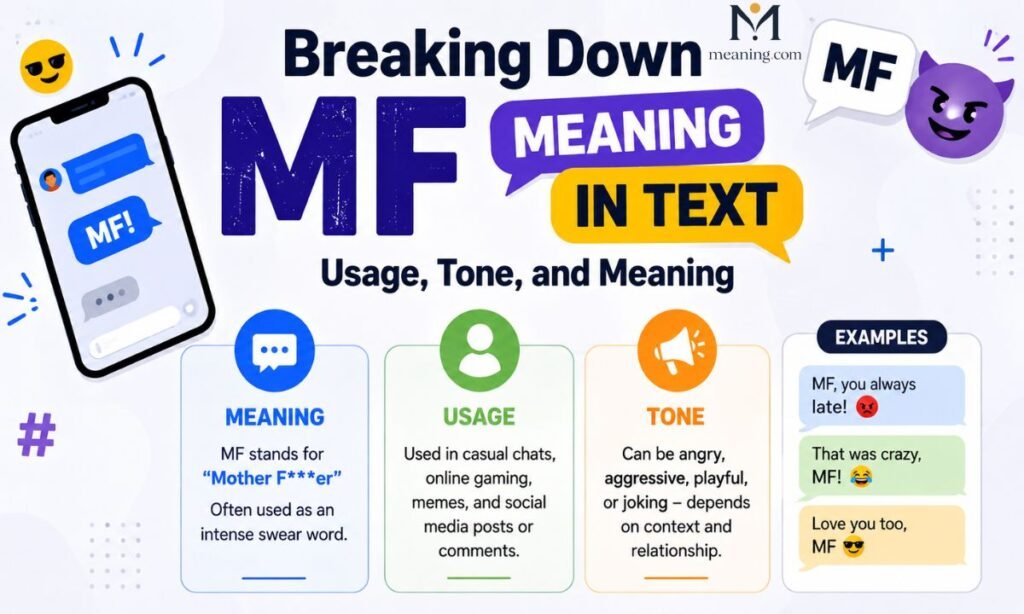
You see “MF” pop up in a text, a comment, or a caption, and for a second you pause. Is it friendly? Is it an insult? Should you be offended or just laugh it off?
This confusion is normal. MF is one of the most common two-letter abbreviations in online slang, and its meaning shifts completely depending on who sends it, how they send it, and where the conversation happens. This guide breaks down everything you need to know: the full form, the origin, the different contexts, and how to respond when it shows up in your own messages.
Full Form of MF & Its Core Meaning

What Does MF Stand For?
The most common full form of MF in slang is “motherf**ker.” That is the version you will see referenced across texting guides, slang dictionaries, and social media discussions.
Literal vs Contextual Meaning
Literally, the word is vulgar. Contextually, it rarely carries that literal weight in casual chats. A message like “you’re a funny MF” is not a literal insult; it is a compliment wrapped in strong language.
Is MF Always Offensive?
No. It can be offensive, playful, admiring, or simply an emphasis word. The relationship between the people talking, the tone of the message, and any emojis attached all change how MF should be read.
Key Takeaways
Quick Summary of MF Meaning
- MF usually stands for “motherf**ker” in texting and social media.
- It can be an insult, a joke, a compliment, or an intensifier.
- Outside slang, MF has unrelated technical meanings (finance, science, aviation).
- Context and tone decide the actual meaning, not the abbreviation alone.
- It is best avoided in formal, professional, or public communication.
When to Use and Avoid MF
| Situation | Safe to Use? | Why |
| Close friends, casual chat | Usually yes | Familiarity softens the tone |
| Gaming voice or text chat | Often yes | Common in competitive banter |
| Social media captions/comments | Sometimes | Depends on audience and platform rules |
| Work email or messages | No | Reads as unprofessional |
| Talking to strangers or new contacts | No | Tone can easily be misread |
Origin, History & Evolution of MF
First Known Use of MF
The full word behind MF has roots in American English slang going back decades, used originally as a harsh insult. The abbreviated “MF” version became common once texting made short-form writing the norm.
How MF Became Popular Online
As SMS and early messaging apps limited character space, people shortened long or explicit words into acronyms. MF became a fast way to type the phrase without spelling it out completely, and the habit carried over into modern chat apps and social platforms.
Cultural Influence & Media Impact
Music, especially hip hop and rap lyrics, played a large role in normalizing the term. Movies, memes, and viral clips later pushed it further into everyday online conversation, where it now appears in captions, reaction posts, and gaming chats.
MF Meaning in Different Contexts
Chat & Messaging (WhatsApp, SMS)
In one-on-one texting, MF often shows up between close friends as a casual, joking term rather than a genuine insult.
Social Media (Instagram, TikTok, Snapchat)
On social platforms, MF appears in captions, comments, and reaction videos, often for comedic or dramatic effect rather than literal anger.
Gaming Communities
In gaming chat and voice comms, MF is common trash talk or hype language, used both to insult opponents and to praise a teammate’s skill.
Dating Apps & Online Conversations
On dating apps, MF is uncommon early on and can come across as too aggressive before trust is built. It appears more once a playful rapport is established.
Professional & Formal Contexts
MF has no place in professional or formal writing. It signals unprofessionalism regardless of the intended tone.
How People Use MF in Daily Conversations

1. As an Insult
“That MF cut me off in traffic.” Here it expresses genuine annoyance or anger toward someone.
2. As a Friendly or Playful Term
“You’re one funny MF.” Between friends, this reads as a compliment, not an insult.
3. To Describe Someone Impressive or Tough
“That coach is one tough MF.” This usage highlights respect for someone’s strength or resilience.
4. To Express Anger or Frustration
“MF, I forgot my wallet again.” Here the speaker directs frustration at themselves, not another person.
5. As an Intensifier for Emphasis
Sometimes MF simply adds emphasis to a sentence, similar to how people use words like “seriously” or “literally” for extra punch.
Tone, Context & Intent Behind MF
Friendly vs Aggressive Usage
The same two letters can sound completely different depending on delivery. A laughing emoji next to MF usually signals playfulness; all caps and exclamation points usually signal anger.
How Tone Changes Meaning
Written text lacks vocal tone, so people rely on punctuation, emojis, and prior conversation history to judge intent. Reading the messages before and after the word helps clarify meaning.
Cultural Sensitivity & Regional Differences
Slang tolerance varies by region, age group, and community. What sounds casual in one group chat might sound harsh or inappropriate in another, so it helps to know your audience.
Other Meanings of MF (Non-Slang)
MF in Physics
In physics and electronics, MF commonly refers to magnetic field or medium frequency, depending on the specific field of study.
MF in Medical Terms
In medical contexts, MF can refer to specific conditions or measurements, and its meaning depends entirely on the clinical setting.
MF in Aviation & Aircraft
In aviation, MF typically stands for medium frequency, a radio frequency band used in navigation and communication systems.
MF in Business, Finance & Tech
In finance, MF most often means Mutual Fund. In technology and product listings, it can stand for Multi-Function, and in photography it can refer to Medium Format.
Why Multiple Meanings Matter
Reading MF correctly requires context. A finance article using MF is discussing mutual funds, not slang, while a text message from a friend is almost certainly using the slang version.
MF Meaning Across Platforms
MF on WhatsApp
On WhatsApp, MF usually appears in personal chats between people who already know each other well, keeping the tone casual.
MF on Instagram
On Instagram, MF shows up in comments and captions, often for humor, reaction, or emphasis rather than direct confrontation.
MF on TikTok
TikTok comments and captions use MF frequently in memes and trending audio, generally in a lighthearted, exaggerated way.
MF on Snapchat
Between close friends on Snapchat, MF often functions as a casual, familiar term rather than an insult.
Differences in Platform Usage
| Platform | Common Tone | Typical Use |
| Casual, personal | Friend-to-friend banter | |
| Mixed | Comments, captions, reactions | |
| TikTok | Playful | Memes, trends, comedic captions |
| Snapchat | Casual, close-knit | Inside jokes between friends |
Common Misconceptions About MF
MF Always Means Insult
Not true. It frequently functions as a compliment or playful nickname among friends.
MF Is Always Rude
Not true. Rudeness depends on tone, relationship, and setting, not the abbreviation alone.
MF Has Only One Meaning
Not true. Outside slang, MF has entirely separate meanings in finance, science, and aviation.
Only Young People Use MF
Not true. While younger users use it more visibly online, the underlying term has been part of casual adult speech for decades.
MF Means the Same Everywhere
Not true. Meaning shifts across platforms, regions, and communities.
Similar Slang Terms & Alternatives
Casual Alternatives (Dude, Bro, etc.)
Words like “dude,” “bro,” and “pal” offer a friendly tone without the harsh edge that MF can carry.
Slang Intensifiers (AF, WTF, etc.)
Terms like “AF” (as f**k) and “WTF” (what the f**k) serve a similar emphasis role in casual writing.
Stronger Informal Variants
Some communities use even more explicit variants for extra emphasis, though these carry a higher risk of sounding harsh or offensive.
Polite Alternatives for Safer Use
Safer substitutes include words like “jerk,” “tough person,” “impressive,” or “annoying,” depending on what you actually mean to say.
Differences Between MF and Similar Words
MF vs Dude
“Dude” is neutral and friendly by default, while MF depends heavily on tone and relationship.
MF vs Bro
“Bro” signals camaraderie without profanity, making it a safer everyday choice than MF.
MF vs WTF
WTF expresses shock or confusion, while MF more often labels a person or intensifies a description.
MF vs AF
AF is purely an intensifier attached to adjectives, while MF can stand alone as a noun referring to a person.
Synonyms & Related Terms to MF

Common Synonyms
Depending on context, synonyms include “jerk,” “tough guy,” “legend,” or “menace,” each fitting a different tone.
Related Internet Slang Terms
Related abbreviations that often appear alongside MF include AF, WTF, GOAT, and SMH, all common in casual digital conversation.
Real-Life Examples of MF in Text
Texting & Social Media Examples
- “That MF never texts back.” (frustration)
- “You mf scared me with that prank!” (playful shock)
Casual Conversation Examples
- “Jordan is one funny MF.” (compliment)
- “MF, I locked my keys in the car again.” (self-directed frustration)
Positive vs Negative Usage Examples
| Example | Tone | Meaning |
| “You’re one talented MF.” | Positive | Compliment on skill |
| “That MF ruined my order.” | Negative | Frustration or anger |
| “Lucky MF, he won again.” | Mixed/Playful | Admiration with a hint of envy |
How to Respond When Someone Uses MF
If It’s Friendly or Playful
Match the energy. A light joke or laughing reply usually keeps the tone consistent.
If It Sounds Aggressive
Stay calm and ask for clarification if needed, since text often loses tone in translation.
If You’re Unsure of Intent
Look at the full conversation and your history with the sender before reacting. Context almost always clears up confusion.
Best Responses in Professional Situations
In a professional setting, it is best to address the underlying issue directly and avoid mirroring the slang.
When Not to Use MF
Formal & Professional Settings
Formal writing, presentations, and business communication should avoid MF entirely.
Workplace Communication
Even in casual workplace chat channels, MF can come across as unprofessional or risky depending on company culture.
Public & Sensitive Situations
Public posts, customer service interactions, and conversations with people you do not know well are not the place for this abbreviation.
Is MF Still Popular in 2026?
Current Trends & Usage Statistics
MF remains a widely used term across texting and social platforms, especially in comment sections, captions, and gaming chats.
Popularity Among Different Age Groups
Younger users tend to use it more visibly online, but the underlying term has long been common in casual adult speech as well.
Future of MF in Digital Communication
As short-form content and casual texting continue to dominate online communication, abbreviations like MF are likely to stay part of everyday digital slang.
Frequently Asked Questions
What does MF mean in a text message?
It usually stands for “motherf**ker,” used as slang for an insult, compliment, or emphasis depending on context.
Is MF always an insult?
No, it can also be playful, admiring, or used simply for emphasis between friends.
Does MF have a non-slang meaning?
Yes, it can mean Mutual Fund in finance, Medium Frequency in aviation, or Magnetic Field in physics.
Is it okay to use MF at work?
No, it is considered unprofessional and should be avoided in workplace or formal communication.
How do I know if MF is meant as a joke or an insult?
Check the tone, emojis, and surrounding conversation, and consider your relationship with the sender.
Is MF used the same way on every platform?
No, usage varies slightly between WhatsApp, Instagram, TikTok, and Snapchat, though the core meaning stays similar.
Conclusion
MF is a small abbreviation with a wide range of meanings. In most texting and social media contexts, it stands for “motherf**ker,” but whether it lands as an insult, a joke, or a compliment depends entirely on tone, relationship, and setting.
Outside slang, the same two letters carry completely different meanings in finance, science, and aviation. The safest approach is simple: read the context before reacting, and skip the abbreviation altogether in formal or professional spaces.

Ethan Brooks is a content creator and SEO professional with 5 years of experience in search engine optimization, content writing, and website growth. I’m passionate about creating helpful, easy-to-understand content that provides real value to readers and performs well in search engines.